3A aramid fabric, 1313 / 1414 blend, woven
93% meta-aramid / 5% para-aramid / 2% antistatic · Woven, 180 – 230 g/m² recorded · Solution-dyed or piece-dyed · Antistatic path carried in the yarn
Our 3A aramid woven fabric family: one cloth carrying a thermal barrier, a rupture-resistant load path and a permanent antistatic path in the same structure. Woven for flame-retardant, antistatic industrial workwear for petrochemical, utility and electrical crews.
- Three fibres in one cloth: thermal barrier, rupture resistance, antistatic
- Antistatic path carried by a conductive component, not a surface finish
- Inherently flame resistant and non-melting — LOI 28–32
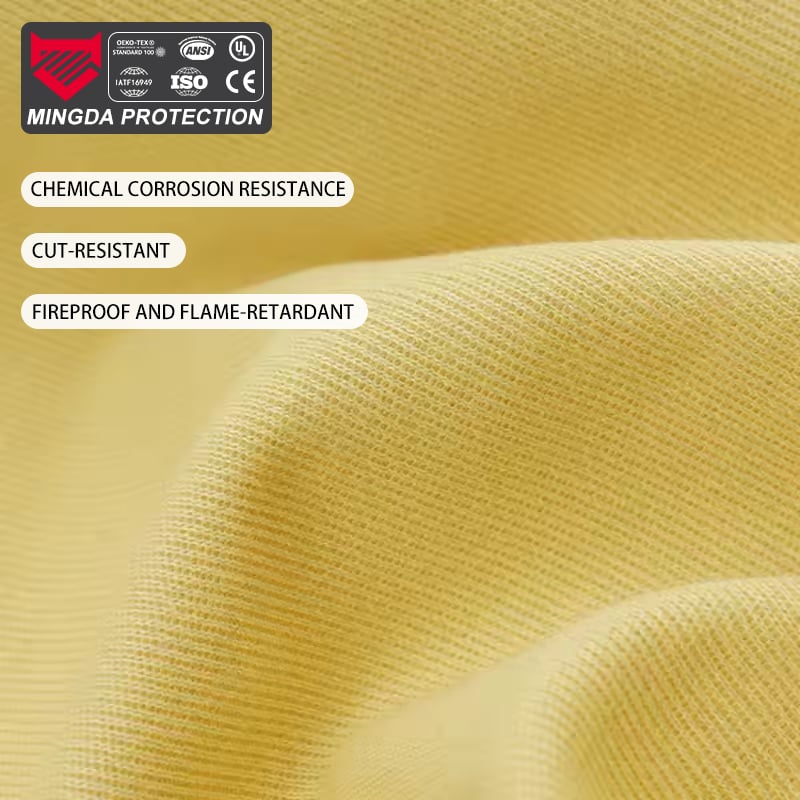
The material
Three fibres, three jobs: what the 93 / 5 / 2 build does in a cloth
The 3A construction is not a blend of convenience. The 93% meta-aramid (aramid 1313) is the thermal barrier: an inherently flame-resistant fibre that chars and builds a carbonised shield instead of melting. The 5% para-aramid (aramid 1414) is the load path: a much stiffer, much stronger fibre that resists rupture and tearing, so the cloth holds together where a pure meta-aramid structure would part. The 2% antistatic component is the conductive path that lets static charge drain away instead of building on the garment.
The antistatic part is where a 3A cloth differs most from a finish-treated fabric. Because the conductive component is spun into the yarn itself it is part of the structure rather than something applied to the surface, so it runs through every square centimetre of the cloth instead of depending on a coating surviving the wash cycle. That is what the antistatic clothing tests are really asking about: a path that is still there after laundering.
Meta-aramid is inherently flame resistant — the property belongs to the polymer, so laundering, dry cleaning and abrasion cannot remove it — and it does not melt or drip. Its limiting oxygen index is 28–32 against the 21% oxygen in ordinary air, which is why the cloth self-extinguishes once the ignition source is removed, and its continuous service temperature is around 250 °C with decomposition only above 370 °C.
With a blend, behaviour follows the mix. The thermal barrier and the rupture resistance are set by the ratio of meta- to para-aramid, and the antistatic performance is set by the conductive component and how evenly it is distributed through the cloth; both are fixed at the spinning stage rather than adjusted afterwards. Thermal, flame and antistatic figures for a specific 3A construction are established by testing that construction, so where a programme needs them we run the test and report the result rather than quoting another construction's number.

Who makes it
Who makes the 3A cloth
Our textile manufacturing roots go back to 1972 and the company was established in Shantou, Guangdong in 2002. All three components of this cloth are spun and converted in a 30,000 m² integrated plant, so the fibre mix is set at the spinning stage under our own control instead of being assembled from bought-in yarns.
This page covers the 3A woven class as a whole. Composition is fixed at 93 / 5 / 2; weight, structure and shade are set with the order. Tell us the hazard the garment is written against and we will confirm the construction, the roll form and the material data that fit it.
Technical data
Product information
The 3A aramid woven cloth we produce. Composition is the same across the class; the rows below carry the weights and widths our records name. Where a record holds no figure we write On request instead of an estimate.
| Series | Composition | Weight | Construction / width | Key property | Source |
|---|---|---|---|---|---|
| 3A aramid fabric | 93% meta-aramid (aramid 1313) / 5% para-aramid (aramid 1414) / 2% antistatic | 180 g/m² | Woven; 180 cm width recorded for this construction | Thermal barrier, rupture resistance and a permanent antistatic path in one cloth | Product record |
| 3A aramid fabric, heavier build | 93% meta-aramid / 5% para-aramid / 2% antistatic | 210 g/m² and 230 g/m² | Woven; navy antistatic version recorded | The same three-component build at a heavier weight | Product record |
| Fabric width | As above | As above | 180 cm recorded for one construction; other widths on request | Width is set with the order against the cutting and spreading line | Product record |
3A aramid woven fabric, 93% meta-aramid / 5% para-aramid / 2% antistatic
The Source column names where each figure comes from: Product record is the specification recorded for that construction in our own product records. Composition is fixed for the class; the weights and the width above are the values our records hold, and a different weight or width is set with the order rather than guessed at here. Woven fabric for protective clothing is assessed at fabric level, so no grade code is printed on this table: the grade is established by testing the construction you order. Where a record holds no figure we write On request instead of an estimate.
Made to order
Specification options
Composition is fixed for this class at 93 / 5 / 2. Weight, structure, width and shade are set with the order; tell us the hazard the garment is written against and the test route your approval file needs, and we will confirm the material data that fit it.
3A cloth is supplied both solution-dyed, where the shade is set in the fibre, and piece-dyed, where it is applied to the woven cloth; navy is the shade our records name for the antistatic version. Which route fits a programme depends on the shade and on how the garment is laundered, and a full shade card is not held for the class, so the colour chips are not printed here. Send the shade reference you use and we will confirm the route and the dyehouse with you.
Standards and certification
This cloth is supplied on material-level data. The items below are the ones we can stand behind for the class today; the fabric-level routes are named in the note, and none of them is printed above as a held result.
- OEKO-TEX® STANDARD 100 Textiles tested for harmful substances. Our fabric certificate covers woven and knitted fabric made from the fibres in its certified list — meta-aramid (raw white) and para-aramid among them — at Product Class II. Where a construction also carries an antistatic component, ask us to confirm the declaration for that exact build alongside the certificate scope.
- ISO 9001 Quality management system.
- REACH SVHC Declaration available on request for the article supplied.
The fabric-level routes for this class are EN ISO 14116:2015 and EN ISO 15025:2016; EN ISO 11612:2015 and EN ISO 11611:2015 taken at fabric level and reported with their performance codes; EN 1149-1 surface resistivity, the route this construction unlocks because the conductive component is spun into the yarn; EN ISO 13997 for cut resistance expressed as a value in newtons; EN IEC 61482-1-1:2019 for an arc rating issued as material data; the ASTM material route of ASTM F1506-22 with ASTM D6413 and ASTM F1959; and NFPA 2112 material testing. Each of those is arranged to the customer's requirement and reported for the production lot, and we hold no report for a construction of this class, so no grade is printed here. Standards written for a finished garment — EN ISO 11612 and NFPA 2112 among them — are assessed on the garment, and that assessment and its certification belong to the garment maker who builds on our material data. Test reports and certificate copies are available from our sales team on request.
Frequently asked questions
What is 3A aramid fabric, and what is it for?
It is a woven cloth built from three components: 93% meta-aramid (aramid 1313), 5% para-aramid (aramid 1414) and 2% antistatic. The meta-aramid carries the thermal barrier, the para-aramid the rupture resistance and the antistatic component the conductive path. It is bought by garment makers for flame-retardant, antistatic industrial workwear in petrochemical, utility and electrical programmes.
How does the antistatic performance work?
Through a conductive component spun into the yarn itself, not through a finish applied to the cloth. Because it is part of the structure it runs through the whole fabric rather than sitting on the surface, so it does not depend on a coating surviving laundering. That is the property the antistatic clothing tests examine, and the route for this construction is EN 1149-1 surface resistivity, which we arrange to your requirement and report for the production lot.
Is the flame resistance inherent?
Yes. The meta-aramid component is inherently flame resistant: the property belongs to the polymer rather than to a finish, so it cannot be washed out, worn off or dry-cleaned away. The cloth does not melt or drip; it chars and builds a carbonised barrier, and its limiting oxygen index of 28–32 against the 21% oxygen in ordinary air is why it self-extinguishes once the ignition source is removed.
What weights and widths can you supply?
The class is recorded at 180 g/m², 210 g/m² and 230 g/m², with a width of 180 cm recorded for one construction and a navy antistatic version recorded at the heavier end. Other widths are set with the order against the cutting and spreading line the cloth runs on. Tell us the garment weight and the roll form you need and we will confirm the specification.
How is the cloth coloured?
Two routes are used: solution-dyed, where the shade is set in the fibre before it is spun, and piece-dyed, where the shade is applied to the woven cloth. Navy is the shade our records name for the antistatic version. Which route a programme should use depends on the shade and on the laundering regime the garment goes through, and we confirm it with the dyehouse before the order is placed.
Does the fabric hold a protective-clothing certification?
No, and we do not present it as if it did. What we supply is material-level data for the cloth. The standards that apply to this class are applied by testing the fabric and reporting its performance codes, and the certification of a finished garment belongs to the garment maker who builds on that data. Where your approval file needs a standard-referenced result on the cloth, we arrange the testing to your requirement and issue the report for the lot.
Let’s talk about your fabric requirements
Tell us the application, the required weight and the standard you need to meet. Our technical team will come back with a matching fabric, the spec sheet and a quotation.