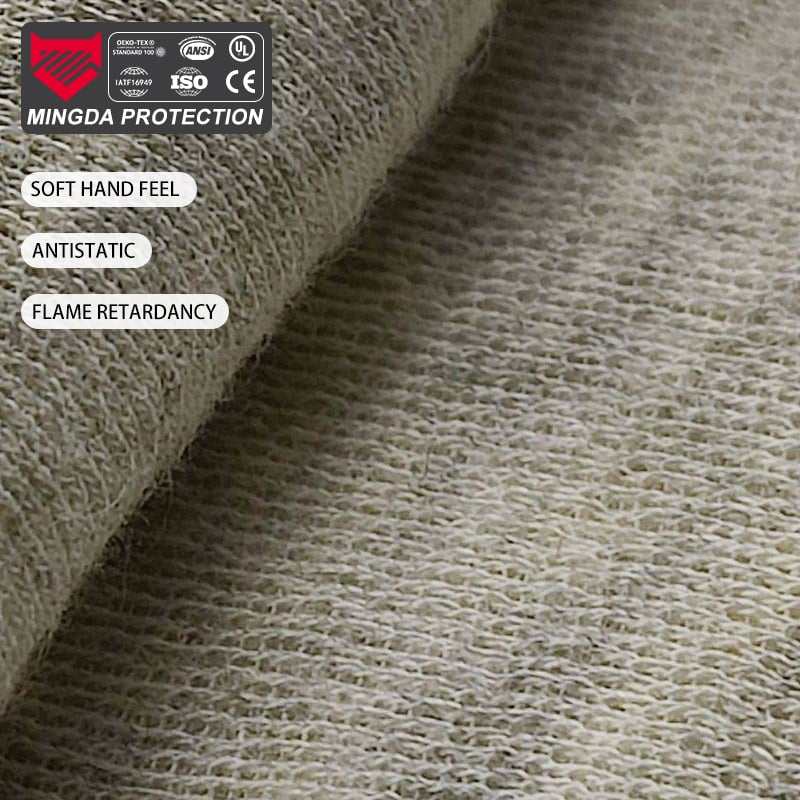
Flash-fire and arc-rated workwear
Outer shells for petrochemical, utility and electrical work, where the garment has to hold its shape and its rating.
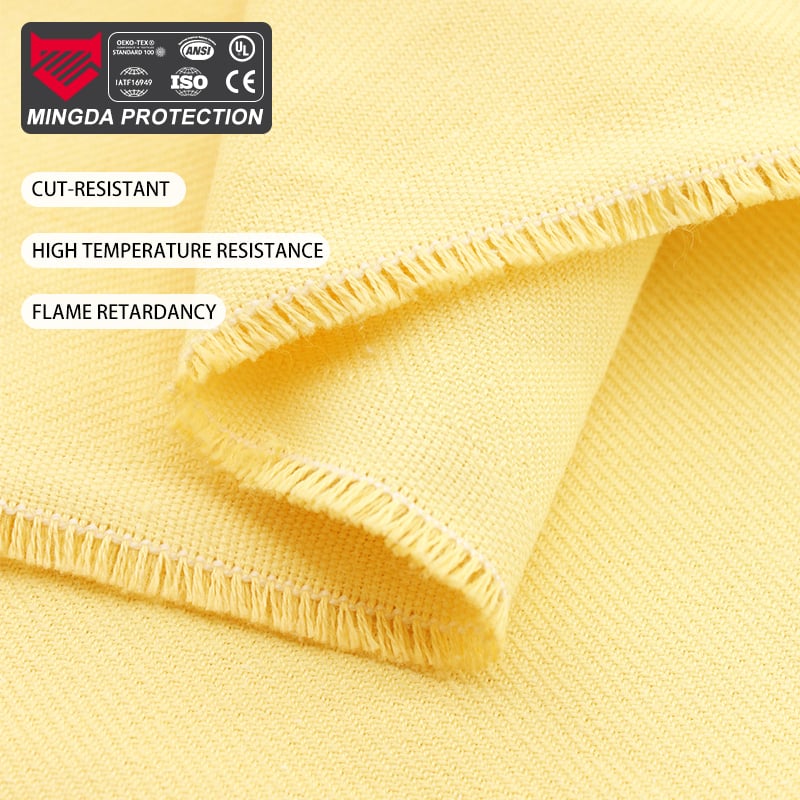
100% para-aramid (aramid 1414) · Woven, 150 – 530 g/m² · Plain, PU / TPU coated and aluminised builds
Our para-aramid woven fabric family: inherently flame-resistant, high-tenacity fabric for garment makers, glove and sleeve producers, and equipment builders working where cut, abrasion and heat hazards meet.
The material
Para-aramid (aramid 1414) is built from rigid, rod-like polymer chains that pack into a highly crystalline structure. That structure is the source of everything the fibre is known for: a tenacity of 20–23 g/den — roughly five times the strength of steel at the same weight — and a very high modulus, so the fibre carries load without stretching away from it.
The same rigidity explains how the fabric feels. Elongation at break is only 3–4%, so para-aramid absorbs energy by resisting rather than extending. That is exactly what makes it effective against cutting and abrasion, and also why it feels stiff and boardy beside a softer fibre — the property that gives the cut protection is the property that takes the drape away.
Thermally, para-aramid does not melt and only decomposes above 450 °C, with a limiting oxygen index of 28–32, so it is self-extinguishing in air. Its long-term service temperature is around 180 °C, judged by strength retention: the fibre is engineered to hold tensile properties, and heat is what erodes them first. Read that as "a strength fibre with good flame behaviour", not as a heat-barrier fibre — insulation is the job meta-aramid does better.
Two limits set the commercial picture. Moisture regain is low at 3–4%, so this is not the fabric to wear against the skin; it belongs in outer shells, reinforcement panels and linings. And colour is effectively fixed at the polymer stage: para-aramid is practically impossible to piece-dye, so only solution-dyed shades such as natural yellow, black and navy are available. UV resistance is poor as well, so outdoor exposure needs a covering layer or a coated, laminated construction.
How it is made
Every woven structure is made by interlacing two sets of yarns at right angles. Every knitted structure is made by looping one yarn through itself. That single difference decides how the fabric performs, and it matters more than the fibre when you are choosing between two fabrics of the same weight.
Woven fabric is dimensionally stable because the yarns are locked at right angles: it resists tearing, resists puncture and holds its shape through repeated laundering, which is why outer shells, reinforcement panels and heavy-duty workwear are woven. The tighter the interlacing, the lower the air permeability — plain weave is the densest of the common structures, twill balances comfort and durability and is the usual choice for flame-retardant coveralls, and ripstop adds a grid of heavier yarns so a light fabric still tears reluctantly.
Knitted fabric is formed from loops, so it stretches, drapes and lets air through far more readily than any woven structure of the same weight. That makes it the right choice for the layer that touches the wearer — inner layers, hoods, balaclavas and glove liners — where breathability and softness matter more than tear strength.
The rule of thumb is short: with the same fibre, woven wins on strength and dimensional stability, knit wins on breathability and comfort. Most protective garment programmes use both — a knit against the wearer and a woven on the outside — and our para-aramid range covers both routes so the two layers can be specified together.
| Structure | Air permeability | What it gives you | Typical use |
|---|---|---|---|
| Plain weave | Lowest | Dense, abrasion resistant, dimensionally stable, resists puncture | Heavy-duty protective workwear, outer shells |
| Twill weave | Medium | Balances comfort with durability | Flame-retardant coveralls — the most common structure |
| Ripstop | Medium to high | Light weight with high tear strength | Lightweight outerwear, summer workwear |
| Knit | Highest | Stretch, softness, next-to-skin comfort | Inner layers, hoods, balaclavas, glove liners |
Technical data
The para-aramid woven fabrics we produce, model by model — the family behind the fabric on this page. Every figure names its source.
| Model | Composition | Weight | Construction / width | Rating or key property | Source |
|---|---|---|---|---|---|
| MD-W002-7 | 100% para-aramid (aramid 1414) | 150 g/m² | Woven plain, 150 cm | On request | Para-aramid catalogue |
| MD-W001-15 | 100% para-aramid (aramid 1414) | 200 g/m² | Woven plain, 150 cm | On request | Para-aramid catalogue |
| W002-1.2 | 100% para-aramid (aramid 1414) | 220 g/m² | Woven plain, 150 cm | LOI above 28% | Index |
| MD-W002-1.2CZ | para-aramid + PU | 250 g/m² | Woven plain + PU coating, 150 cm | On request | Para-aramid catalogue |
| MD-W002-1.5CD | para-aramid + PU | 270 g/m² | Woven plain + PU coating, 150 cm | On request | Para-aramid catalogue |
| MD-W001-15CA | para-aramid + TPU | 270 g/m² | Woven plain + TPU coating, 140 cm | On request | Para-aramid catalogue |
| MD-W002-3 | 100% para-aramid (aramid 1414) | 280 g/m² | Woven plain, 150 cm | Cut level A2 (ANSI/ISEA 105) | Para-aramid catalogue |
| MD-W002-8 | para-aramid + polyester | 280 g/m² | Woven plain, 150 cm | On request | Para-aramid catalogue |
| MD-S-488.1 | 100% para-aramid (aramid 1414) | 310 g/m² | Woven plain, 80 – 220 cm | On request | Para-aramid catalogue |
| MD-W002-8CD | para-aramid / polyester + PU | 330 g/m² | Woven plain + PU coating, 150 cm | On request | Para-aramid catalogue |
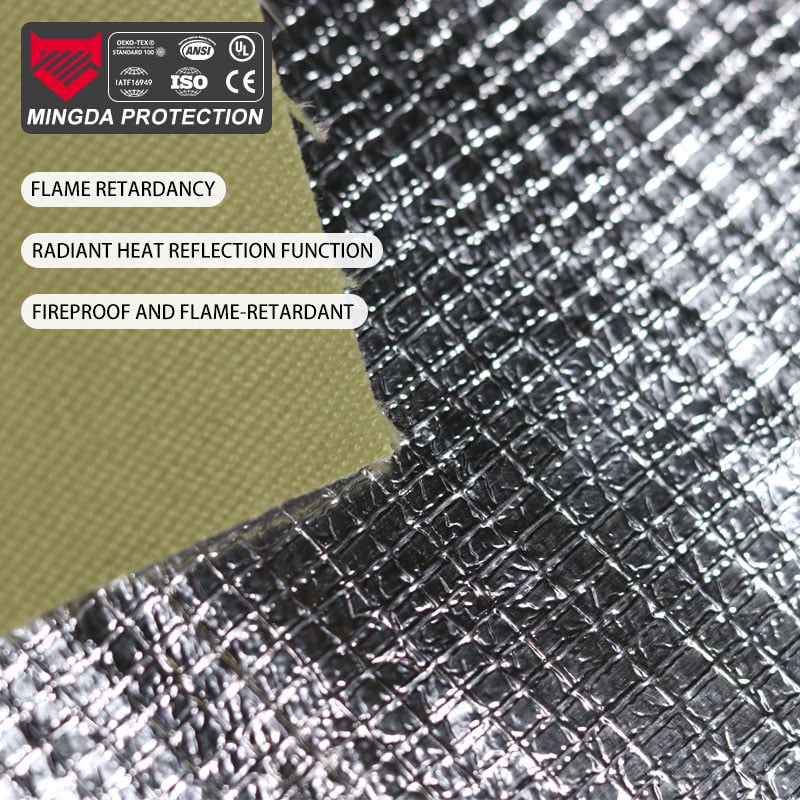
| MD-W002-3AL | 100% para-aramid + aluminium foil | 360 g/m² | Woven + aluminium foil, 150 cm | On request | Para-aramid catalogue |
| MD-W002-6AL | para-aramid + aluminium foil | 415 g/m² | Woven + aluminium foil, 150 cm | On request | Para-aramid catalogue |
| MD-S-405AL | para-aramid + aluminium foil | 530 g/m² | Woven + aluminium foil, 120 cm | On request | Para-aramid catalogue |
The Source column names where each figure comes from: Index is our product information index, Para-aramid catalogue is the internal para-aramid fabric catalogue it records. W002-1.2 is the fabric on this page. Where the catalogue records no cut or heat rating we write On request rather than an estimate — the test report for your specification is arranged on request.
Made to order
Weight, width and construction are set to the end use; colour follows the fibre, which for para-aramid means solution-dyed shades.
Para-aramid takes its colour in the polymer before the fibre is spun, not in a dye bath, so the choice is limited to solution-dyed shades — natural yellow, black and navy blue in regular supply. Tell us the shade and we will confirm it for the weight and construction you have chosen.
Para-aramid is sensitive to light; store and use it away from direct sunlight.
Our products are made to conform to each standard listed below, in the application it is bought for. Where a certificate for a specific standard is required, we arrange testing to the customer's requirement.
Test reports and certificate copies are available from our sales team on request. Standards written for finished garments — EN ISO 11612, NFPA 2112, NFPA 1971 — belong to the garment maker who builds on our material data.
In service
Para-aramid woven fabric is specified where a garment has to survive heat and mechanical abuse at the same time — an outer layer that carries the load while a knit or meta-aramid layer looks after the wearer.
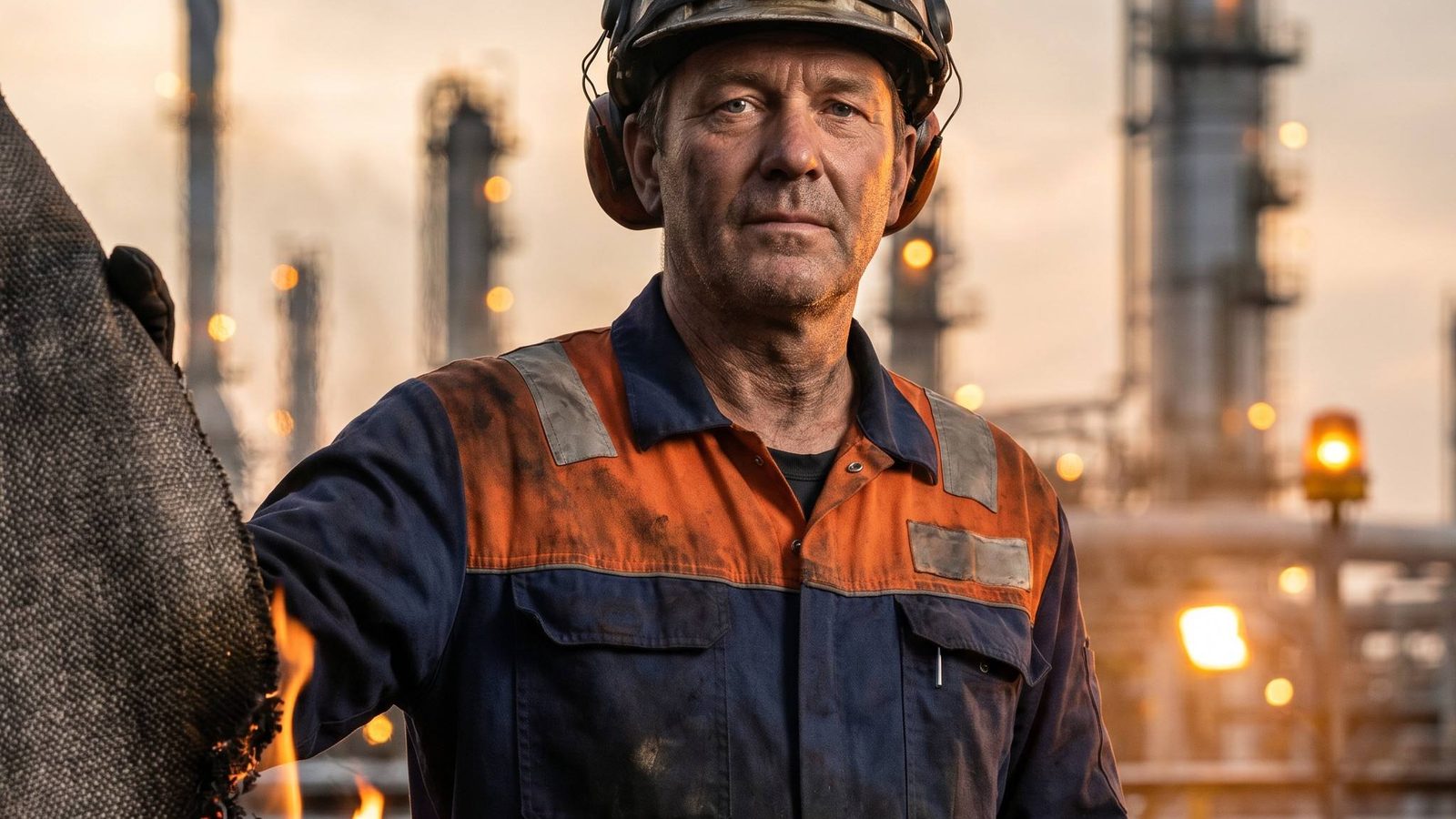
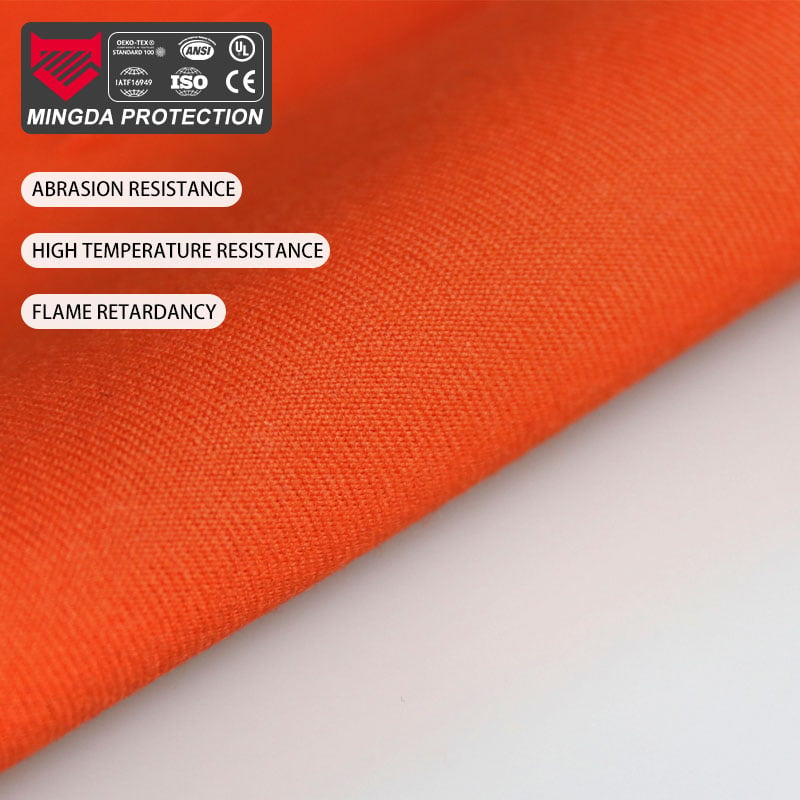
Outer shells for petrochemical, utility and electrical work, where the garment has to hold its shape and its rating.
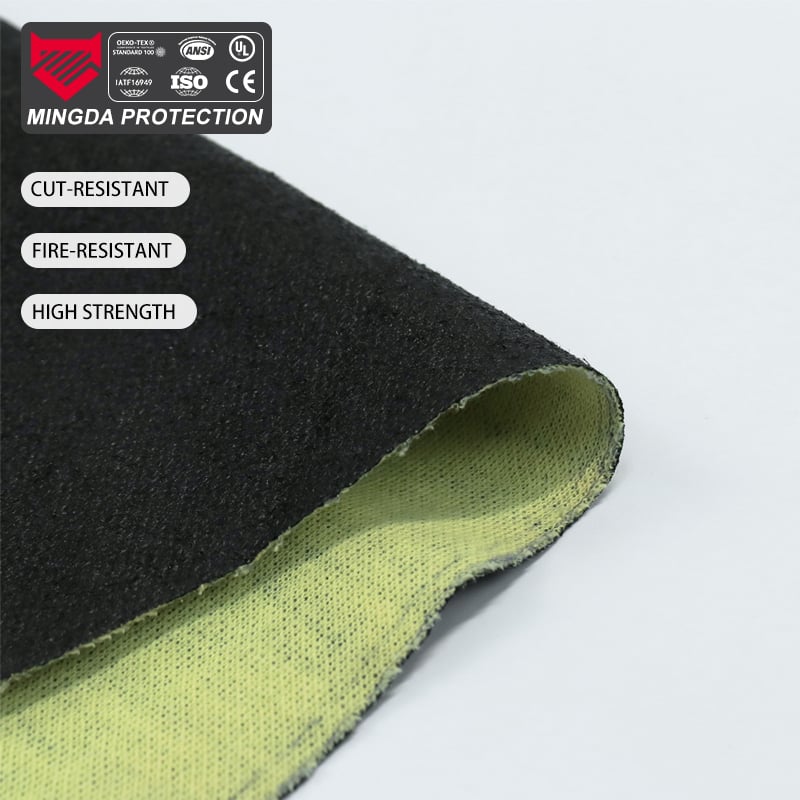
High-tenacity yarn resists cutting and abrasion at glass, sheet-metal and fabrication benches.
Woven shells and reinforcement panels that resist tearing and abrasion through repeated laundering.
Dimensionally stable fabric for screens and blankets used close to sparks and radiant heat.
Yes. Para-aramid is inherently flame resistant: it does not melt, it has a limiting oxygen index (LOI) of 28–32 and it only decomposes above 450 °C. Because the property belongs to the polymer rather than to a chemical finish, it does not wash out or wear off. What does change in service is strength rather than flame behaviour — long-term heat exposure above about 180 °C erodes tensile properties first.
On an equal-weight basis, yes. Para-aramid runs at 20–23 g/den tenacity, roughly five times the strength of steel wire of the same weight, which is why it is used where cutting and abrasion carry the risk. The same structure that produces that strength limits elongation at break to 3–4%, so the fabric resists an edge rather than stretching away from it — and feels stiffer than a softer fibre of the same weight.
Because para-aramid is practically impossible to piece-dye. Colour has to be added to the polymer before the fibre is spun — solution dyeing — so the shade range is fixed at the fibre stage and is limited to the shades that are actually produced, such as natural yellow, black and navy blue. This is a property of the fibre, not a supply decision: a dyehouse cannot open the range later.
Yes. Para-aramid has poor UV resistance — prolonged direct sunlight degrades the fibre, and the loss shows up as strength rather than as a visible colour change. For outdoor service, specify a construction that shields the para-aramid: a covering layer, a laminated or coated build, or a design that keeps the fabric out of direct exposure.
Choose woven where strength, dimensional stability, cut and puncture resistance matter — outer shells, reinforcement panels, heavy-duty workwear. Choose knit where breathability, stretch and next-to-skin comfort matter — inner layers, hoods and glove liners. The two are normally used together in one garment: a knit against the wearer and a woven on the outside.
EN ISO 11612 is the European garment standard for heat and flame protective clothing, and NFPA 2112 is the US standard for flash fire protection. Both certify the finished garment, not the roll of fabric, so they are met by the garment maker who builds on our material data. The same para-aramid base fabric can support both programmes; the certification route is chosen by your market and by the garment certifier.
They are EN ISO 11612 performance codes. A1 and A2 cover surface and edge flame spread (ISO 15025), B1 to B3 cover convective heat (ISO 9151), C1 to C4 cover radiant heat (ISO 6942), D1 to D3 cover molten aluminium splash and E1 to E3 molten iron splash (ISO 9185), and F1 to F3 cover contact heat (ISO 12127). A garment usually carries the combination its application demands, such as A1 B1 C1 for general flame and radiant heat work.
The arc rating of a material is determined by testing to ASTM F1959, which produces the ATPV figure used in arc-rated clothing programmes together with ASTM F1506 and NFPA 70E in the US, or IEC 61482-2 in Europe. Third-party test reports for the material and the requested test can be provided on request.
Tell us the application, the required weight and the standard you need to meet. Our technical team will come back with a matching fabric, the spec sheet and a quotation.