Cut-resistant fabric for gloves, sleeves and aprons
High-tenacity yarn resists cutting and abrasion at glass, sheet-metal and fabrication benches, and is why para-aramid is the reference fibre for EN 388 and ANSI/ISEA 105 programmes.
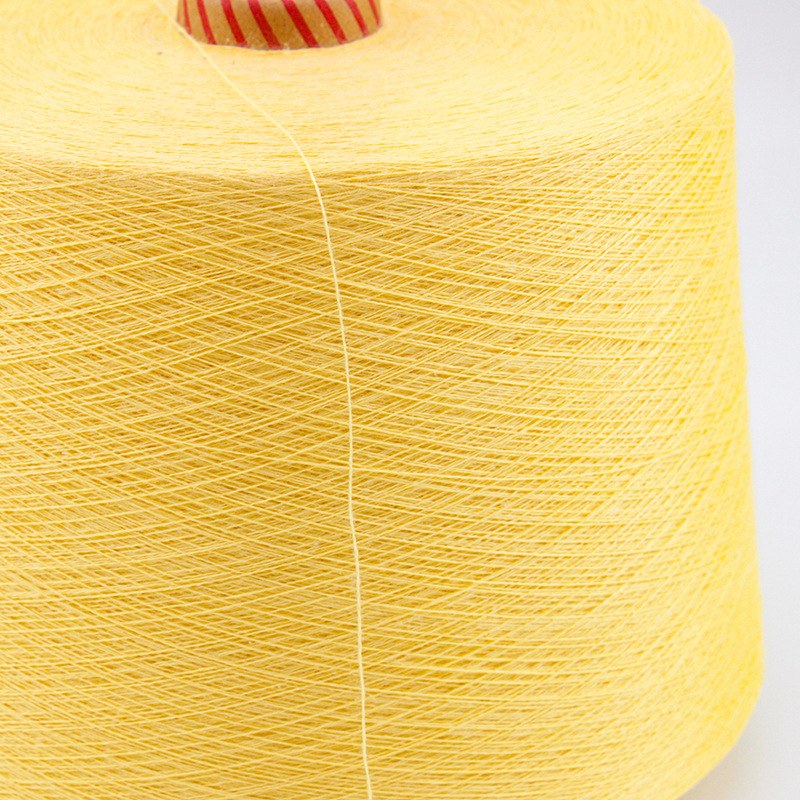
100% para-aramid (aramid 1414) · Spun Ne 8s – Ne 60s and filament 200D – 3000D · Siro-spun and compact Siro-spun
Our para-aramid yarn family: the high-tenacity, high-modulus aramid for the mills that weave and knit cut-resistant fabric, for glove, sleeve and apron makers, and for reinforcement and composite builders. Supplied as single, two-ply and multi-ply spun yarn and as continuous filament, spun and twisted in our own mill.
The material
Para-aramid (aramid 1414) is built from rigid, rod-like polymer chains that pack into a highly crystalline structure. Everything the fibre is known for follows from that one fact: a tenacity of 20–23 g/den, roughly five times the strength of steel wire at the same weight, and a very high modulus, so the yarn carries load instead of stretching away from it. Because the yarn is what the cutter actually meets, that strength reaches the finished gloves, sleeves and reinforcement panels.
The same rigidity explains how the yarn handles. Elongation at break is only 3–4%, so it absorbs energy by resisting rather than extending — which is exactly what makes it effective against cutting and abrasion, and also why a para-aramid fabric feels stiff and boardy beside a softer fibre. The property that gives the cut protection is the property that takes the drape away, and a knitter or weaver has to plan for that rather than fight it.
Thermally, para-aramid is inherently flame resistant: it does not melt, its limiting oxygen index (LOI) is 28–32, and it only decomposes above 450 °C, so it self-extinguishes once the ignition source is removed. Its long-term service temperature is around 180 °C, judged by strength retention — the fibre is engineered to hold tensile properties and heat erodes those first. Read it as a strength fibre with good flame behaviour, not as a heat barrier: insulation is the job meta-aramid does better.
Two limits set the commercial picture, and both matter most at the yarn stage. Moisture regain is low at 3–4%, so the yarn is for outer shells, reinforcement and linings rather than a layer worn against the skin. And colour is effectively fixed in the polymer: para-aramid is practically impossible to piece-dye, so only solution-dyed shades such as natural yellow, black and navy blue are available at the spinning stage. UV resistance is poor as well, so outdoor service needs a covering layer or a coated, laminated build.
How it is made
We spin our para-aramid yarn with two ring-spinning variants — Siro-spun and compact Siro-spun. Both start from drafted staple fibre, and both attack the same weakness: a spun yarn is only as good as the fibres held inside its body, because every fibre end left on the surface is a defect that later shows up as pilling, a rougher surface and faster abrasion.
In conventional ring spinning a single drafted strand is twisted into yarn, and the twist runs back into a triangular zone — the spinning triangle — where outer fibres can escape before they are bound in. Siro-spun feeds two rovings side by side through the same drafting zone and the same spinning triangle, so the two strands twist around each other as they form. The yarn that comes out is wrapped rather than combed: fewer fibre ends protrude, and the linear density is more even along the length of the yarn.
Compact Siro-spun adds a compacting stage before twisting. A suction or air current draws the fibre ends back into the yarn body and removes the spinning triangle altogether, so nearly every fibre is trapped inside the structure instead of lying loose on the surface. In practice that gives the tightest surface, the highest yarn tenacity of the two routes and the best evenness — the reason it is the route we use where the yarn will be woven or knitted into a fabric whose appearance and abrasion life matter.
The difference is easiest to see downstream. Plainer yarn throws more fly and carries more surface fibres, which turns into a rougher fabric surface, faster pilling and quicker abrasion at cuffs, knees and pocket edges. Compact Siro-spun yarn runs cleaner through the loom or the knitting machine, gives a smoother and denser surface, and holds its appearance longer in cut-resistant service. Yarn properties are measured per production lot, so ask our technical team for the current spinning data for the count and ply you plan to use.
| Spinning route | How the yarn is formed | What it gives the fabric |
|---|---|---|
| Conventional ring-spun | One drafted roving twisted into a yarn; the spinning triangle stays open. | The baseline: usable, but hairier and less even, so the fabric surface is rougher and wears faster. |
| Siro-spun | Two rovings drafted and twisted together in the same spinning triangle, then plied. | Lower hairiness and better evenness than ring-spun; fewer protruding fibre ends on the woven or knitted surface. |
| Compact Siro-spun | As Siro-spun, with a compacting stage that pulls loose fibre ends back into the yarn body before twisting. | The tightest surface, the highest tenacity and the best evenness of the three — our route for appearance-critical fabric. |
Every figure below is a value our own mill recorded in the test report for the model named beside it, quoted as recorded. Spun yarn rows and sewing-thread rows sit apart on purpose: they are different products from different test lots, so read the row label rather than the column when you compare us with another supplier. Where the file name does not match the model inside the sheet, the model the sheet names is the one used here.
Para-aramid is the strength fibre in our range. On the models measured so far, breaking tenacity runs 74.6–88.5 cN/tex, elongation at break 2.88–4.88%, and evenness 7.71–16.73% CVm; the best single result in each row is named beside the range. Low elongation is the point rather than a defect — the yarn resists an edge instead of stretching away from it — and it is why para-aramid yarn is specified where cut resistance and dimensional stability carry the load.
All values are measured per production lot, so the figures here describe what our yarn is delivering now rather than a guaranteed ceiling. Tell our technical team the count and ply you plan to use and we will send the batch test data for it.
| Property | Our measured range | Best recorded value | Source |
|---|---|---|---|
| Breaking tenacity — yarn (cN/tex) | 74.6 – 88.5 | 88.5 (P303YT Ne 30s/3) | P303YT.xlsx |
| Breaking tenacity — sewing thread (cN/tex) | 67.4 – 93.4 | 93.4 (P203FYT Ne 20s/3) | P203F.xlsx |
| Breaking force — yarn (cN) | 1108.05 – 9857.2 | 9857.2 (P204(YT) Ne 20s/4) | P204(YT).xlsx |
| Elongation at break — yarn (%) | 2.88 – 4.88 | 4.88 (P204(YT) Ne 20s/4) | P204(YT).xlsx |
| Elongation at break — sewing thread (%) | 3.03 – 4.64 | 4.64 (P203FYT Ne 20s/3) | P203F.xlsx |
| Evenness CVm% — yarn | 7.71 – 16.73 | 7.71 (P204(YT) Ne 20s/4) | P204(YT).xlsx |
| Tenacity CV% — yarn | 2.55 – 11.54 | 2.55 (P204(YT) Ne 20s/4) | P204(YT).xlsx |
| Twist irregularity CV% — yarn | 2.09 – 5.97 | 2.09 (P204(YT) Ne 20s/4) | P204(YT).xlsx |
Technical data
The para-aramid yarns we produce, model by model — the family behind the yarn on this page. Every measured figure names its source.
| Model | Composition | Count | Ply / construction | Rating or key property | Source |
|---|---|---|---|---|---|
| P20YT | 100% para-aramid (aramid 1414) | Ne 20s | Single | Breaking tenacity 80.8 cN/tex | P20YT.xlsx |
| P202BH | 100% para-aramid (aramid 1414) | Ne 20s | Two-ply | Breaking tenacity 86.3 cN/tex | P202BH.xlsx |
| P202YT-1 | 100% para-aramid (aramid 1414) | Ne 20s | Two-ply | Breaking tenacity 86.6 cN/tex | P202YT-1.xlsx |
| P204(YT) | 100% para-aramid (aramid 1414) | Ne 20s | Four-ply | Breaking tenacity 80.9 cN/tex; breaking force 9857.2 cN | P204(YT).xlsx |
| P25YT | 100% para-aramid (aramid 1414) | Ne 25s | Single | Breaking tenacity 79.1 cN/tex | P25YT.xlsx |
| P252BH | 100% para-aramid (aramid 1414) | Ne 25s | Two-ply | Breaking tenacity 80 cN/tex | P252BH.xlsx |
| P282YT | 100% para-aramid (aramid 1414) | Ne 28s | Two-ply | Breaking tenacity 82.4 cN/tex | P282YT.xlsx |
| P30YT | 100% para-aramid (aramid 1414) | Ne 30s | Single | Breaking tenacity 80.9 cN/tex | P30YT.xlsx |
| P302YT | 100% para-aramid (aramid 1414) | Ne 30s | Two-ply | Breaking tenacity 84.2 cN/tex | P302YT.xlsx |
| P303YT | 100% para-aramid (aramid 1414) | Ne 30s | Three-ply | Breaking tenacity 88.5 cN/tex | P303YT.xlsx |
| P401YT | 100% para-aramid (aramid 1414) | Ne 40s | Single | Breaking tenacity 74.6 cN/tex | P40YT.xlsx |
| P402YT | 100% para-aramid (aramid 1414) | Ne 40s | Two-ply | Breaking tenacity 77.1 cN/tex | P402YT.xlsx |
| Para-aramid filament yarn | 100% para-aramid (aramid 1414) | 200D / 400D / 600D / 800D / 1000D / 1200D / 1500D / 2500D / 3000D | Continuous filament | MD-P200D: 216 dtex, 133 F, 43.7 cN, 20.23 cN/tex | Index · 529S 200D report |
| High-strength heat-resistant para-aramid yarn | 100% para-aramid (aramid 1414) | On request | On request | On request | Index |
The Source column names where each figure comes from: Index is our product information index, the other entries are the specification sheet issued for that model. P401YT is the model named inside the file P40YT.xlsx. Values are measured per production lot, so ask our technical team for the batch data of the count and ply you plan to use. Where a model carries no recorded rating we write On request rather than an estimate.
Made to order
Count, ply and composition are set to the fabric you are building; colour is set by the polymer, which for para-aramid means solution-dyed shades.
Para-aramid takes its colour in the polymer before the fibre is spun, not in a dye bath, so the choice is limited to solution-dyed shades — natural yellow, black and navy blue in regular supply. Tell us the shade and we will confirm it for the count and ply you have chosen.
Para-aramid is sensitive to light; store and use it away from direct sunlight.
Our products are made to conform to each standard listed below, in the application it is bought for. Where a certificate for a specific standard is required, we arrange testing to the customer's requirement.
Test reports and certificate copies are available from our sales team on request. Standards written for finished garments — EN ISO 11612, NFPA 2112, NFPA 1971 — belong to the garment maker who builds on our material data.
In service
Para-aramid yarn is bought for one purpose above all: to be woven or knitted into fabric that has to resist cutting, tearing and abrasion, and to hold its shape while it does so. The spinning route decides how cleanly the yarn runs on the machine; the count and ply decide the strength the finished fabric reaches.
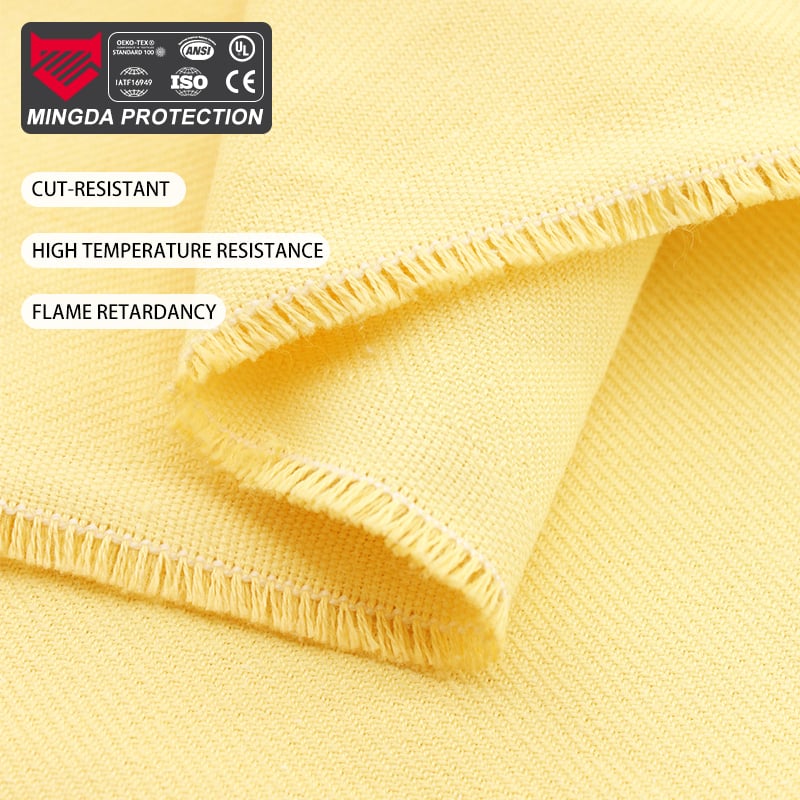
High-tenacity yarn resists cutting and abrasion at glass, sheet-metal and fabrication benches, and is why para-aramid is the reference fibre for EN 388 and ANSI/ISEA 105 programmes.
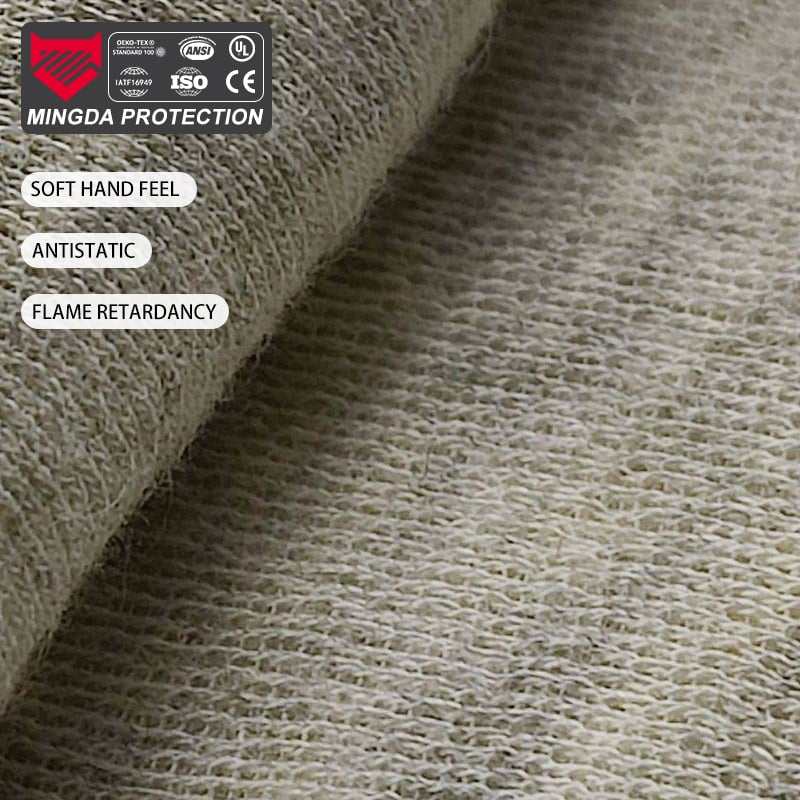
Plain and twill constructions for outer shells where the garment has to hold its shape, its tear strength and its rating through repeated laundering.
Dimensionally stable yarn for reinforcement plies, tapes and composite substrates, where a stiff, high-modulus fibre is an advantage rather than a compromise.
Para-aramid (aramid 1414) is the strength fibre: 20–23 g/den tenacity, roughly five times the strength of steel at equal weight, a very high modulus and only 3–4% elongation. Meta-aramid (aramid 1313) is the heat and comfort fibre: it chars and insulates instead of melting, and it can be worn against the skin. Choose para-aramid where cut resistance, tear strength and dimensional stability carry the load; choose meta-aramid for thermal protection and next-to-skin comfort. Many protective programmes use both, one in the shell and one in the layer against the wearer.
Yes. The flame resistance belongs to the polymer, not to a chemical finish, so it cannot be washed out, worn off or dry-cleaned away. Para-aramid does not melt, it has a limiting oxygen index (LOI) of 28–32 against the 21% oxygen in air, and it only decomposes above 450 °C, so it self-extinguishes once the ignition source is removed. What does change in service is strength rather than flame behaviour: long-term exposure above about 180 °C erodes tensile properties first.
On an equal-weight basis, yes. Para-aramid runs at 20–23 g/den tenacity, roughly five times the strength of steel wire of the same weight, which is why it is used where cutting and abrasion carry the risk. Our own measured yarn tenacity sits between 74.6 and 88.5 cN/tex depending on count and ply. The same structure that produces that strength limits elongation at break to 3–4%, so the yarn resists an edge rather than stretching away from it.
Because para-aramid is practically impossible to piece-dye. Colour has to be added to the polymer before the fibre is spun — solution dyeing — so the shade range is fixed at the fibre stage and is limited to the shades that are actually produced, such as natural yellow, black and navy blue. This is a property of the fibre, not a supply decision: a dyehouse cannot open the range later. If a programme needs another colour, the shade has to come from the fibre supplier.
Yes. Para-aramid has poor UV resistance — prolonged direct sunlight degrades the fibre, and the loss shows up as strength rather than as a visible colour change. For outdoor service, specify a construction that shields the para-aramid: a covering layer, a laminated or coated build, or a design that keeps it out of direct exposure. Storage in the mill follows the same rule, which is why our cones and rolls are kept out of direct light.
They are two different scales and cannot be converted directly. EN 388 is the European glove and material standard, and its levels are lettered (A to F on the 2016 version, which uses the ISO 13997 TDM test for cut resistance in place of the older coupe test). ANSI/ISEA 105 is the US standard and its cut levels are numbered A1 to A9. A buyer working to both markets has to test to both, which is why we record both where a test exists and write On request where it does not.
Around 180 °C continuously, judged by strength retention rather than by melting or ignition. Para-aramid does not melt at all and only decomposes above 450 °C, but heat erodes its tensile properties before it damages the flame behaviour, so the working limit for a load-bearing yarn is set by strength. Where the requirement is insulation rather than strength at temperature, a meta-aramid yarn is the more suitable choice.
Ask for the test report for the production lot. Tenacity, elongation at break, evenness and twist are measured per lot, and the figures on this page are the values recorded for the models named beside them. Where an independent result is needed for your own approval file, third-party test reports can be provided on request.
Tell us the application, the required weight and the standard you need to meet. Our technical team will come back with a matching fabric, the spec sheet and a quotation.