Coated and laminated protective fabric, aluminised and coated constructions
Aramid and high-strength substrates · Aluminised, PU-coated and TPU-coated laminates · 250 – 530 g/m² recorded in the para-aramid range · Every construction tested as a complete assembly
Our coated and laminated class: aluminised, PU-coated and TPU-coated constructions built on inherently flame-resistant or high-strength substrates. Supplied with the material data for the construction you order, on the rule that decides this class — a laminate is one assembly and is assessed as one.
- Aluminised and coated laminates on aramid and high-strength substrates
- Base-fabric data does not transfer: the laminate is tested as a complete assembly
- The article-level substance position is stated for the exact construction supplied
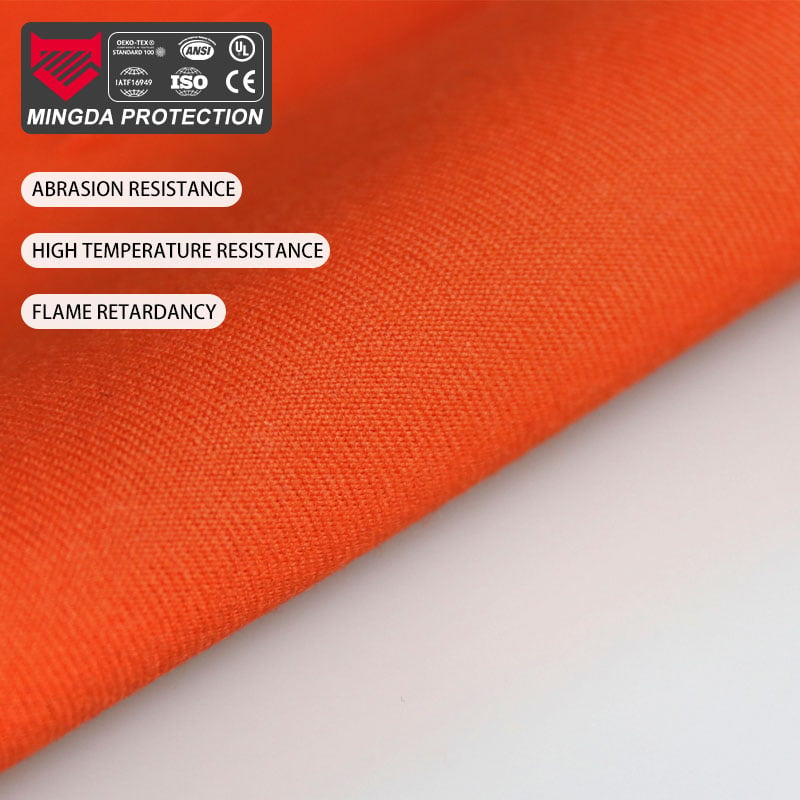
The material
A coating or a laminate is a new construction, not a treated cloth
The sentence that decides this class is short: a flame-resistant base fabric does not make a flame-resistant laminate. Coating a cloth or bonding a membrane to it adds a component with its own combustion behaviour, and that component can make the whole construction worse — a coating that burns, drips or raises smoke density changes the result even when the substrate under it is inherently flame resistant. It works in the other direction too, which is why this class is worth specifying: an aluminium-foil lamination substantially improves radiant-heat performance, and the aluminised builds in the range are the ones that reach the higher radiant-heat bands. Nothing in this class can be inferred from the composition, and no figure can be carried across from a substrate to a laminate. Every coated and laminated construction is measured as a complete assembly.
What a laminate is matters more here than on a plain cloth, because there are three components doing work. The substrate carries the strength, the coating or the foil decides the surface behaviour, and the adhesive or the bonding route holds the two together — and the laminate takes its properties from all three. Our substrates are the ones we make: para-aramid (aramid 1414) woven cloth, which is inherently flame resistant; aramid and pre-oxidised felt; and UHMWPE (HPPE) woven cloth, which is a cut-and-abrasion material and not a flame-resistant one. A coated UHMWPE construction is therefore a mechanical-protection laminate and is labelled as such on this page, because a buyer who takes it for an FR construction would be buying the wrong material.
Chemically, this is the class we screen hardest, and it is worth saying why. A coating or a membrane is itself an article for REACH purposes: in a complex article the 0.1% threshold is checked against each constituent article rather than against the whole, so the coating, the adhesive and the substrate each have to be accounted for. PVC and flexible coatings commonly use phthalate plasticisers, and several phthalates are on the SVHC candidate list; a laminating adhesive can carry SVHC as well. That is why we work from the coating supplier’s own safety data sheet and substance declaration, and why the declaration we issue is issued for the exact article supplied rather than for the class. Azo dyes under REACH Annex XVII entry 43 are a tested route for a dyed or coated cloth. RoHS is not a regulation that applies to textiles, so this page states no RoHS position for a coated article; where a programme screens for phthalates, the answer is the substance declaration for the construction.
What we supply is material data for the construction: substrate, coating or foil, weight, width and roll form, plus the test report for the production lot. What a laminate does under a flame, a radiant heat source, a water jet or a chemical splash is established by testing the assembly you order, and the certification of a finished garment belongs to the garment maker who builds on it. Base-fabric test data cannot be transferred to a coated or laminated version — ask for the report for your construction, and read that report against the construction it names.
Who makes it
Who makes the laminate
Our textile manufacturing roots go back to 1972 and the company was established in Shantou, Guangdong in 2002. The substrates on this page — para-aramid woven cloth, aramid felt and UHMWPE cloth — are spun and converted in a 30,000 m² integrated plant, so the cloth under the coating is ours rather than bought in and coated.
This page covers the coated and laminated class as a whole: the aluminised and PU- or TPU-coated builds of the para-aramid range, the pre-oxidised felt laminate, and the coated UHMWPE constructions recorded for cut and puncture duty. Substrate, coating or foil, weight and width are set with the order, and each construction is quoted together with the substance position for the exact article, because in this class the two cannot be separated.
Technical data
Product information
The coated and laminated constructions our records carry, with the substrate, the coating or the foil, and the recorded weight and width. Every figure names its source. Where a record holds no figure — or holds two that disagree — we write On request instead of choosing one.
| Model | Substrate and coating | Weight | Construction / width | Rating or key property | Source |
|---|---|---|---|---|---|
| MD-W002-1.2CZ | Para-aramid (aramid 1414) woven + PU coating | 250 g/m² | Woven plain + PU coating, 150 cm | Coated build; the result belongs to the laminate and is established by testing it | Para-aramid catalogue |
| MD-W002-1.5CD | Para-aramid (aramid 1414) woven + PU coating | 270 g/m² | Woven plain + PU coating, 150 cm | Coated build; the result belongs to the laminate and is established by testing it | Para-aramid catalogue |
| MD-W001-15CA | Para-aramid (aramid 1414) woven + TPU coating | 270 g/m² | Woven plain + TPU coating, 140 cm | Coated build; the result belongs to the laminate and is established by testing it | Para-aramid catalogue |
| MD-W002-8CD | Para-aramid / polyester woven + PU coating | 330 g/m² | Woven plain + PU coating, 150 cm | Coated build on a blended substrate; tested as the laminate | Para-aramid catalogue |
| MD-W002-3AL | 100% para-aramid (aramid 1414) woven + aluminium foil | 360 g/m² | Woven + aluminium foil, 150 cm | Aluminised build, the construction this class records as improving radiant-heat performance; the code is pursued by testing the laminate | Para-aramid catalogue |
| MD-W002-6AL | Para-aramid (aramid 1414) woven + aluminium foil | 415 g/m² | Woven + aluminium foil, 150 cm | Aluminised build, for radiant-heat duty; established by testing the laminate | Para-aramid catalogue |
| MD-S-405AL | Para-aramid (aramid 1414) woven + aluminium foil | 530 g/m² | Woven + aluminium foil, 120 cm | Aluminised build at the heaviest recorded weight of the range | Para-aramid catalogue |
Coated and aluminised constructions of the para-aramid range
| Construction | Substrate and coating | Weight | Construction / width | Rating or key property | Source |
|---|---|---|---|---|---|
| Pre-oxidised felt laminate | Pre-oxidised (oxidised PAN) felt + aluminium facing | On request | Nonwoven felt laminated with an aluminium facing; width on request | No weight and no width is recorded for this laminate, so none is printed | Product record |
| WT-OP-280AL | Pre-oxidised fibre twill + aluminium coating | On request | Woven twill + aluminium coating; width unconfirmed | Our records for this construction give two different weights and widths, so no figure is printed until it is confirmed | Product record · records conflict |
| Coated UHMWPE (HPPE) twill, S-482 | UHMWPE and polyester twill with a black coating | 880 g/m² | Woven twill, coated | Not flame resistant — the base fibre melts rather than charring, so this is a cut and puncture construction only | Legacy record |
| Black TPU-coated UHMWPE fabric | UHMWPE (HPPE) with a black TPU coating | 700 g/m² | Woven, coated | Not flame resistant — cut and puncture duty only | Legacy record |
Coated constructions on our other substrates
The Source column names where each figure comes from: Para-aramid catalogue is the internal catalogue of the para-aramid fabric range, Product record is the specification our records carry for that construction, and Legacy record is the construction as our legacy catalogue carries it. No rating, code or class is printed on either table, because in this class the result belongs to the assembly: a coated or laminated construction is tested as a complete assembly and base-fabric test data cannot be transferred to it. One row above is printed with no weight and no width on purpose — our records under WT-OP-280AL give two different figures for the same construction, and neither is confirmed, so neither is printed and the value is confirmed with your order. The two coated UHMWPE rows are cut and puncture constructions and are labelled as not flame resistant, because their base fibre melts. Where our records hold no figure we write On request rather than an estimate.
Made to order
Specification options
Substrate, coating or foil, weight and width are set with the order. Tell us the hazard the construction is written against and the screening list your programme works to, and we will confirm the construction and the material data that fit it.
Colour in this class is decided by two things: the substrate underneath and the coating or foil on the face. Where the substrate is our para-aramid woven cloth, colour follows the fibre — para-aramid is practically impossible to piece-dye, so only solution-dyed shades such as natural yellow, black and navy are recorded for that range — and an aluminium-foil face is metallic by its nature. A coated build takes the colour of the coating system as well, and no shade card is held for the coated and laminated class, so the colour chips are not printed here. Send the shade reference your programme uses with the construction you are specifying, and we will confirm it with the coating line before the order is placed.
Standards and certification
A coated or laminated construction is supplied on material data for the construction, and this is the class we screen most carefully. The two items below are the ones we can stand behind today; the routes that have to be established by testing the assembly are named in the note, and none of them is printed above as a held result.
- ISO 9001 Quality management system.
- REACH SVHC Declaration available on request for the exact article supplied, coating or membrane, adhesive and substrate accounted for separately.
Nothing in this class is inferred from the composition. A coating or a laminate is a complete assembly, so every construction is tested as one, and base-fabric test data cannot be transferred to a coated or laminated version — ask for the report for your construction. The routes in this class, each arranged to the customer’s requirement and reported for the production lot, are: EN ISO 11612:2015, where the coated or laminated assembly is re-tested and a substrate report cannot substitute for it; EN ISO 11611:2015, which coated and laminated structures commonly serve under in welding protection; EN 343 / EN ISO 24232, the water penetration and breathability route this class is often bought for, where the class records Class 3 from 1,300 mm and Class 4 from 2,000 mm hydrostatic head and the class for a construction is established by testing it; EN 14325, the materials, seams and components standard that has to be passed before a chemical-protection Type classification is attempted; EN 13034, the Type 6 / 6B light-splash route, which is not protection against immersion or sustained chemical exposure; EN 14605 for Type 3 and Type 4; EN ISO 14116:2015 and EN ISO 15025:2016 at material level; EN 1149-1 and EN 1149-5, where a coating can interrupt the conductive path and a conductive base cloth has to be re-tested after coating; EN IEC 61482-1-1:2019, where the arc rating of a coated assembly is measured rather than taken from the substrate; and the ASTM material routes of ASTM F2700, ASTM D6413 and ASTM F1959. ASTM F1506-22 is a material-level specification with durability and after-wash requirements attached, so a coated or laminated construction may not reach it; test a sample of your construction before the order is committed. Under NFPA 2112 a coated fabric can be tested, but declaring the material to that standard requires third-party certification, and the certification of a garment belongs to the garment maker; NFPA 1970 is a finished firefighter- and rescue-equipment standard and coated laminated structures appear in it as outer and rescue layers. EN ISO 20471 and EN ISO 13688 are finished-garment standards and are not applied to this cloth; ANSI/ISEA 105 and ANSI/ISEA 138 are finished hand-protection standards, and the lettered cut and impact grades belong to the finished glove rather than to a roll of coated fabric. On the chemical side, REACH SVHC is mandatory for this class and is the highest screening risk on the site: the coating or the membrane is itself an article, phthalates used as plasticisers in PVC and flexible coatings are the live question, and a laminating adhesive can carry SVHC as well, which is why we ask for the coating supplier’s safety data sheet and substance declaration before a construction is quoted. REACH Annex XVII entry 43, the azo dye route, is arranged for a dyed or coated cloth on the same basis. RoHS is not a regulation that applies to textiles, so no RoHS position is stated for a coated article; where a programme screens for phthalates, the answer is the substance declaration for the exact article supplied. Test reports and certificate copies are available from our sales team on request.
Frequently asked questions
What does coated and laminated mean, and why can the substrate’s test data not be used?
A coated fabric is a cloth with a coating applied to one or both faces; a laminated fabric is a cloth bonded to a film, a membrane or a foil. Either way the construction has three components doing work — the substrate, the coating or foil, and the adhesive or bonding route — and the assembly takes its properties from all three. A flame-resistant substrate does not make a flame-resistant laminate: the coating can burn, drip or raise smoke density, and that changes the result of the whole construction. This is why base-fabric test data cannot be transferred to a coated or laminated version, and why every construction in this class is tested as a complete assembly.
Does an aluminium foil face improve the heat performance?
Yes, and it is the reason the aluminised builds are in the range. Aluminium-foil lamination substantially improves radiant-heat performance, which is the C code band of EN ISO 11612, and an aluminised construction is the version of this class that is worth putting forward for a high radiant-heat duty. It is a route to be proven rather than a result we can quote: the code your construction reaches is established by testing that construction, and we hold no report for a construction of this class, so no code is printed on this page.
Is a PU, TPU or PVC coating flammable?
A coating or a membrane is a component in its own right, and what matters is how the assembly behaves, not how the coating behaves alone: a coating that burns, drips or raises smoke density can make the overall burning behaviour of the laminate worse than that of the cloth it sits on, and a coating can also interrupt a conductive path in a base cloth that was built for antistatic duty. That is exactly why this class is tested rather than reasoned about. We do not state a combustion result for a coating on its own, and we do not state a result for a laminate until the assembly has been tested.
What does REACH require for a coated fabric?
More than for a plain cloth, and at article level. In a complex article the 0.1% SVHC threshold is assessed against each constituent article rather than against the whole, so the coating or membrane, the adhesive and the substrate each have to be accounted for. PVC and flexible coatings commonly use phthalate plasticisers, several of which are on the SVHC candidate list, and a laminating adhesive can carry SVHC too. In practice that means we ask the coating supplier for the safety data sheet and the substance declaration for the material in your construction, and the declaration we issue with the goods is issued for the exact article supplied. Azo dyes under REACH Annex XVII entry 43 are a tested route for a dyed or coated cloth. RoHS, for its part, is not a regulation that applies to textiles, so we state no RoHS position for a coated article.
Which weights and widths can you supply in this class?
The para-aramid coated and aluminised constructions are recorded from 250 g/m² to 530 g/m², at widths of 120 cm to 150 cm, and the coated UHMWPE constructions at 700 g/m² and 880 g/m². The pre-oxidised felt laminate carries no recorded weight or width, and one construction in our records gives two different weights and widths that contradict each other, so both are shown as On request rather than with a figure we would have to guess. Tell us the substrate, the duty and the roll form your line runs, and we will confirm the construction and its weight and width for the order.
Do you supply a coated UHMWPE fabric, and is it flame resistant?
Yes, two coated UHMWPE (HPPE) twills are recorded in this class, at 880 g/m² and 700 g/m², and both are cut and puncture constructions. Neither is flame resistant: the base fibre melts rather than charring, which is why no flame, heat, arc or molten-metal requirement is offered for them, and why the lettered cut grades a glove or a sleeve carries are issued on the finished article rather than on a roll of coated cloth. If the hazard is heat or flame rather than a sharp edge, an aluminised or coated aramid build is the right material in this class.
How is the performance of a laminate verified before ordering?
Ask for the test report for the production lot, and read it against the construction it names, because in this class the result belongs to the assembly and not to the substrate. Weight, width, substrate and coating are recorded per lot. Where your approval file needs a standard-referenced result on the construction, the testing is arranged to your requirement and reported for the lot, and where your own route needs an independent laboratory result, third-party test reports can be provided on request. The certification of a finished garment built on the laminate belongs to the garment maker.
Let’s talk about your fabric requirements
Tell us the application, the required weight and the standard you need to meet. Our technical team will come back with a matching fabric, the spec sheet and a quotation.