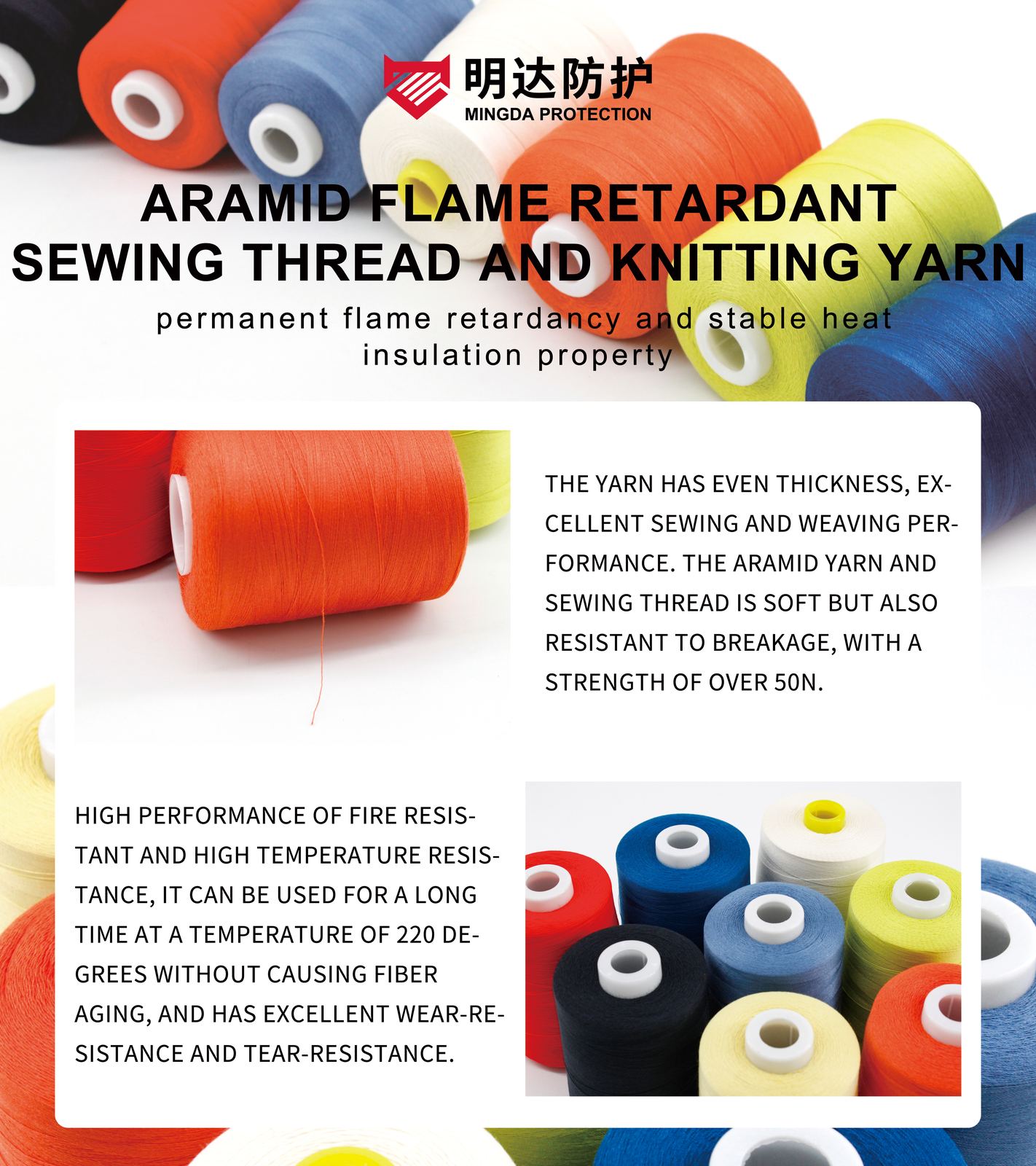
Aramid sewing thread
100% para-aramid and 100% meta-aramid sewing thread · Ne 20s – Ne 60s · Two-ply to six-ply
Our aramid sewing thread family: the thread that holds a flame-resistant garment together. Para-aramid thread for the seams that have to carry the most load and the most abrasion, meta-aramid thread where a softer seam and a wider colour range matter — both inherently flame resistant and non-melting, twisted and finished in our own mill.
- Inherently flame resistant and non-melting — the seam keeps its protection
- 100% para-aramid and 100% meta-aramid, Ne 20s – Ne 60s
- Two-ply to six-ply, spun and twisted in our own mill
The material
Why the thread is where a flame-resistant garment fails first
A protective garment is only as good as its weakest line, and that line is almost always the seam. Seams concentrate load, they are the place where a garment is abraded when it is put on and taken off, and they are stitched at the highest density of any part of the assembly. If the thread in that seam is not flame resistant and does not melt, the shell can still hold its rating while the seam opens; if the thread melts, it can do so against the wearer. That is the whole argument for an aramid sewing thread.
Both aramid families are inherently flame resistant: the property belongs to the polymer rather than to a finish, so laundering, dry cleaning and abrasion cannot remove it, and neither fibre melts or drips. Para-aramid reaches 20–23 g/den tenacity with 3–4% elongation, which is why it is the thread for the load-bearing seams — shoulders, crotch, waistbands and pocket corners — and for cut-resistant assemblies where the seam is the place a blade is most likely to find an opening. Meta-aramid runs 5–6 g/den with 20–30% elongation, which gives a softer, more forgiving seam and a thread that can be dyed across a wider range of shades.
Elongation is the difference you can feel in the finished garment. A low-elongation para-aramid thread makes a stiff, dimensionally stable seam that resists stretching and pilling at the needle line; a higher-elongation meta-aramid thread lets the seam move with the fabric, which matters on a knit or on a garment that has to be donned and doffed repeatedly. Many programmes use both in the same garment, choosing per seam rather than per garment.
Colour follows the fibre. Para-aramid is practically impossible to piece-dye, so the shade is set in the polymer before spinning and the range is limited to solution-dyed colours such as natural yellow, black and navy blue. Meta-aramid does dye, so it can be matched to the fabric across a much wider range — which is why a garment whose seams have to disappear into the fabric is usually specified in meta-aramid thread even when the shell is para-aramid.
How it is made
How we spin it: Siro-spun and compact Siro-spun
We spin our aramid thread with two ring-spinning variants — Siro-spun and compact Siro-spun — and then fold and finish it for the needle. Both routes start from drafted staple fibre, and both attack the same weakness: a thread is only as good as the fibres held inside its body, and every fibre end left on the surface is a defect that shows up as a weak spot at the needle line.
In conventional ring spinning a single drafted strand is twisted into yarn, and the twist runs back into a triangular zone — the spinning triangle — where outer fibres can escape before they are bound in. Siro-spun feeds two rovings side by side through the same drafting zone and the same spinning triangle, so the two strands twist around each other as they form. The yarn that comes out is wrapped rather than combed: fewer fibre ends protrude, and the linear density is more even along the length of the yarn.
Compact Siro-spun adds a compacting stage before twisting. A suction or air current draws the fibre ends back into the yarn body and removes the spinning triangle altogether, so nearly every fibre is trapped inside the structure instead of lying loose on the surface. In practice that gives the tightest surface, the highest yarn tenacity of the two routes and the best evenness — which is what a sewing thread needs, because an uneven thread abrades against the needle and the fabric at every stitch and breaks at its thinnest place.
The thread is then plied to the count and ply the seam requires and finished so it runs cleanly at speed: the ply decides the breaking force, and the finish decides how the thread behaves in the needle and in the seam. Because breaking force, evenness and twist are all measured per production lot, ask our technical team for the batch data of the count and ply you plan to run, together with the seam recommendation for the fabric you are stitching.
| Spinning route | How the thread is formed | What it gives the seam |
|---|---|---|
| Conventional ring-spun | One drafted roving twisted into a yarn; the spinning triangle stays open. | The baseline: usable, but hairier and less even, so the thread abrades at the needle and breaks at its thin places. |
| Siro-spun | Two rovings drafted and twisted together in the same spinning triangle, then plied. | Lower hairiness and better evenness than ring-spun; a cleaner run through the needle and a more uniform seam. |
| Compact Siro-spun | As Siro-spun, with a compacting stage that pulls loose fibre ends back into the yarn body before twisting. | The tightest surface and the best evenness of the three — our route for high-speed stitching and appearance-critical seams. |
Measured quality of our aramid sewing thread
Every figure below is a value our own mill recorded in the test report for the model named beside it, quoted as recorded. The table covers sewing thread only — spun yarns are a different product with their own test lots and are recorded on the yarn pages rather than mixed in here.
Para-aramid thread is the strength thread, so its tenacity sits far above the meta-aramid range: measured breaking tenacity runs 67.4–93.4 cN/tex, with the plied Ne 20s/3 and Ne 30s/2 constructions at the top of that band. Meta-aramid thread is the comfort and colour thread, measured at 24–29.7 cN/tex, and its best evenness result across the range is 4.45% CVm — the most uniform thread we have measured.
All values are measured per production lot, so the figures here describe what our thread is delivering now rather than a guaranteed ceiling. Tell our technical team the count and ply you are running and we will send the batch test data for it.
| Property | Para-aramid thread | Meta-aramid thread | Source |
|---|---|---|---|
| Breaking tenacity (cN/tex) | 67.4 – 93.4 (best 93.4, P203FYT Ne 20s/3) | 24 – 29.7 (best 29.7, M204F Ne 20s/4) | P203F.xlsx · M204F.xlsx |
| Breaking force (cN) | 1332.3 – 8301.2 (best 8301.2, P203FYT Ne 20s/3) | 579.35 – 5277.1 (best 5277.1, M206F Ne 20s/6) | P203F.xlsx · M206F.xlsx |
| Elongation at break (%) | 3.03 – 4.64 | 15.94 – 27.49 | P203F.xlsx · M206F.xlsx |
| Evenness CVm% | 10.45 – 14.91 (best 10.45, P403FYT Ne 40s/3) | 4.45 – 12.6 (best 4.45, M206F Ne 20s/6) | P403FYT.xlsx · M206F.xlsx |
| Tenacity CV% | 4.12 – 7.74 (best 4.12, P203FYT Ne 20s/3) | 1.19 – 6.94 (best 1.19, M205F Ne 20s/5) | P203F.xlsx · M205F.xlsx |
| Twist irregularity CV% | 3.14 – 4.97 (best 3.14, P203FYT Ne 20s/3) | 1.67 – 4.73 (best 1.67, M205F Ne 20s/5) | P203F.xlsx · M205F.xlsx |
Technical data
Product information
The aramid sewing threads we produce, model by model — para-aramid first, then meta-aramid. Every measured figure names its source.
| Model | Composition | Count | Ply | Rating or key property | Source |
|---|---|---|---|---|---|
| P203FYT-X | 100% para-aramid | Ne 20s | Three-ply | Breaking tenacity 93.4 cN/tex; breaking force 8301.2 cN | P203F.xlsx |
| P203FYT | 100% para-aramid | Ne 20s | Three-ply | Breaking tenacity 88.4 cN/tex; breaking force 7832 cN | P203FYT-2.xlsx |
| P302FYT | 100% para-aramid | Ne 30s | Two-ply | Breaking tenacity 93 cN/tex | P302FYT.xlsx |
| P303FYT | 100% para-aramid | Ne 30s | Three-ply | Breaking tenacity 86.5 cN/tex | P303FYT.xlsx |
| P402FYT | 100% para-aramid | Ne 40s | Two-ply | Breaking tenacity 83.9 cN/tex | P402FYT.xlsx |
| P403FYT | 100% para-aramid | Ne 40s | Three-ply | Breaking tenacity 83.7 cN/tex; evenness 10.45% CVm | P403FYT.xlsx |
| P602FYT | 100% para-aramid | Ne 60s | Two-ply | Breaking tenacity 67.4 cN/tex | P602FYT.xlsx |
| M422 | 100% meta-aramid | Ne 42s | Two-ply | EN ISO 11612 (as recorded for this model) | Index |
| M202Fsk | 100% meta-aramid | Ne 20s | Two-ply | Breaking tenacity 28.7 cN/tex; twist irregularity 2.37% CV | M202Fsk.xlsx |
| M203F | 100% meta-aramid | Ne 20s | Three-ply | Breaking tenacity 28.3 cN/tex; breaking force 2647.1 cN | M203F.xlsx |
| M204F | 100% meta-aramid | Ne 20s | Four-ply | Breaking tenacity 29.7 cN/tex; breaking force 3655.75 cN | M204F.xlsx |
| M205F | 100% meta-aramid | Ne 20s | Five-ply | Tenacity CV 1.19%; twist irregularity 1.67% CV | M205F.xlsx |
| M206F | 100% meta-aramid | Ne 20s | Six-ply | Breaking force 5277.1 cN; evenness 4.45% CVm | M206F.xlsx |
| M302F | 100% meta-aramid | Ne 30s | Two-ply | Breaking tenacity 27.2 cN/tex | M302F.xlsx |
| M303F | 100% meta-aramid | Ne 30s | Three-ply | Breaking tenacity 29.2 cN/tex | M303F.xlsx |
| M403FSK-3 | 100% meta-aramid | Ne 40s | Three-ply | Breaking tenacity 27.5 cN/tex | M403F.xlsx |
| M502F (1.5D) | 100% meta-aramid | Ne 50s | Two-ply | Breaking tenacity 24 cN/tex; evenness 12.6% CVm | M502F(1.5D).xlsx |
The Source column names where each figure comes from: Index is our product information index, the other entries are the specification sheet issued for that model. Values are measured per production lot, so ask our technical team for the batch data of the count and ply you plan to run. Where a model carries no recorded rating we write On request rather than an estimate.
Made to order
Specification options
Count and ply are set to the seam and the fabric it is stitching; colour depends on which aramid family the thread is made from.
- Natural (raw white)
- Yellow (natural para-aramid)
- Navy blue
- Black
The two thread families colour differently. Para-aramid takes its colour in the polymer before spinning, so its range is limited to solution-dyed shades such as natural yellow, black and navy blue. Meta-aramid dyes, so it can be matched across a much wider range and to an approved reference — which is why a seam that has to disappear into the fabric is usually stitched in meta-aramid thread.
Para-aramid thread is sensitive to light; store and use it away from direct sunlight.
Standards and certification
Our products are made to conform to each standard listed below, in the application it is bought for. Where a certificate for a specific standard is required, we arrange testing to the customer's requirement.
- EN ISO 11612 Heat and flame protective clothing — the standard a seam has to survive along with the shell.
- NFPA 2112 Flash fire protection for industrial personnel.
- NFPA 1971 Structural firefighting protective clothing.
- ASTM F1506 Flame-resistant textile materials for arc-rated clothing.
- EN ISO 13997 Cut resistance of the seam on assemblies where the thread is the last line against a blade.
- EN 388 Mechanical risks — the cut, abrasion and puncture tests behind a glove rating.
- OEKO-TEX® STANDARD 100 Textiles tested for harmful substances.
- ISO 9001 Quality management system.
Test reports and certificate copies are available from our sales team on request. Standards written for finished garments — EN ISO 11612, NFPA 2112, NFPA 1971 — belong to the garment maker who builds on our material data.
Frequently asked questions
Why does an FR garment need an aramid sewing thread?
Because the seam is the weakest line in the garment. Seams concentrate load, they are abraded whenever the garment is put on or taken off, and they carry the tightest stitching in the assembly. A thread that is not flame resistant can burn away and open the seam; a thread that melts can do so against the wearer, which is the specific failure protective clothing standards exist to prevent. A para-aramid or meta-aramid thread is inherently flame resistant, does not melt, and holds its strength at the seam.
How does count and ply translate into thread strength?
For a given count, breaking force rises with the number of plies, and our own measurements show the step clearly. On meta-aramid Ne 20s thread the recorded values are 2647.1 cN at three-ply, 3655.75 cN at four-ply, 4246.25 cN at five-ply and 5277.1 cN at six-ply (M203F.xlsx, M204F.xlsx, M205F.xlsx, M206F.xlsx). On para-aramid the strongest recorded result is 8301.2 cN at Ne 20s/3 (P203F.xlsx). Higher ply means a heavier seam, so the ply is chosen to the load the seam actually carries.
Should I use para-aramid or meta-aramid thread?
Para-aramid thread is the strength thread: measured breaking tenacity runs 67.4–93.4 cN/tex with only 3–4% elongation, so it makes a stiff, dimensionally stable seam that resists abrasion and cutting. Meta-aramid thread runs 24–29.7 cN/tex with much higher elongation, so it makes a softer seam that moves with the fabric, and it dyes across a wider shade range. Use para-aramid where the seam carries load or faces a blade; use meta-aramid where comfort, hand and colour matching decide the choice.
Does the thread have to be the same fibre as the fabric?
No — but it does have to be compatible with it. Both aramid families are inherently flame resistant and non-melting, so either can be used on either fabric without introducing a melting component. What changes is behaviour: a para-aramid thread on a knit gives a stiffer seam, and a meta-aramid thread on a woven shell gives a seam that moves more and can be colour matched. The usual practice is to select per seam rather than per garment, and to check the seam against the same standard the shell is certified to.
Will the seam survive the same laundering as the shell?
It should, because the flame resistance of both aramid families is inherent — it belongs to the polymer, not to a finish — and neither fibre melts or drips. Abrasion and laundering do not remove the protection. What laundering does affect is appearance: thread that is finer or less even than the fabric will show at the needle line after repeated washing, which is why thread evenness matters as much as thread strength. Our best measured evenness is 4.45% CVm (M206F, meta-aramid Ne 20s/6).
Why can I only get a few colours in para-aramid thread?
Because para-aramid is practically impossible to piece-dye. The colour has to be put into the polymer before the fibre is spun, so the range is fixed at the fibre stage and is limited to solution-dyed shades such as natural yellow, black and navy blue. Meta-aramid dyes in the ordinary way, so it can be matched to an approved reference across a much wider range — the practical reason a seam that has to be invisible is stitched in meta-aramid thread.
How do I verify the thread specification before ordering?
Ask for the test report for the production lot. Breaking tenacity, breaking force, elongation, evenness and twist are measured per lot, and the figures on this page are the values recorded for the models named beside them. Where an independent result is needed for your own approval file, third-party test reports can be provided on request.
Let’s talk about your fabric requirements
Tell us the application, the required weight and the standard you need to meet. Our technical team will come back with a matching fabric, the spec sheet and a quotation.