
Woven FR and antistatic workwear
Plain, twill and ripstop constructions for coveralls and jackets in flame-retardant and antistatic programmes, where the garment has to hold both its protection and its shape.
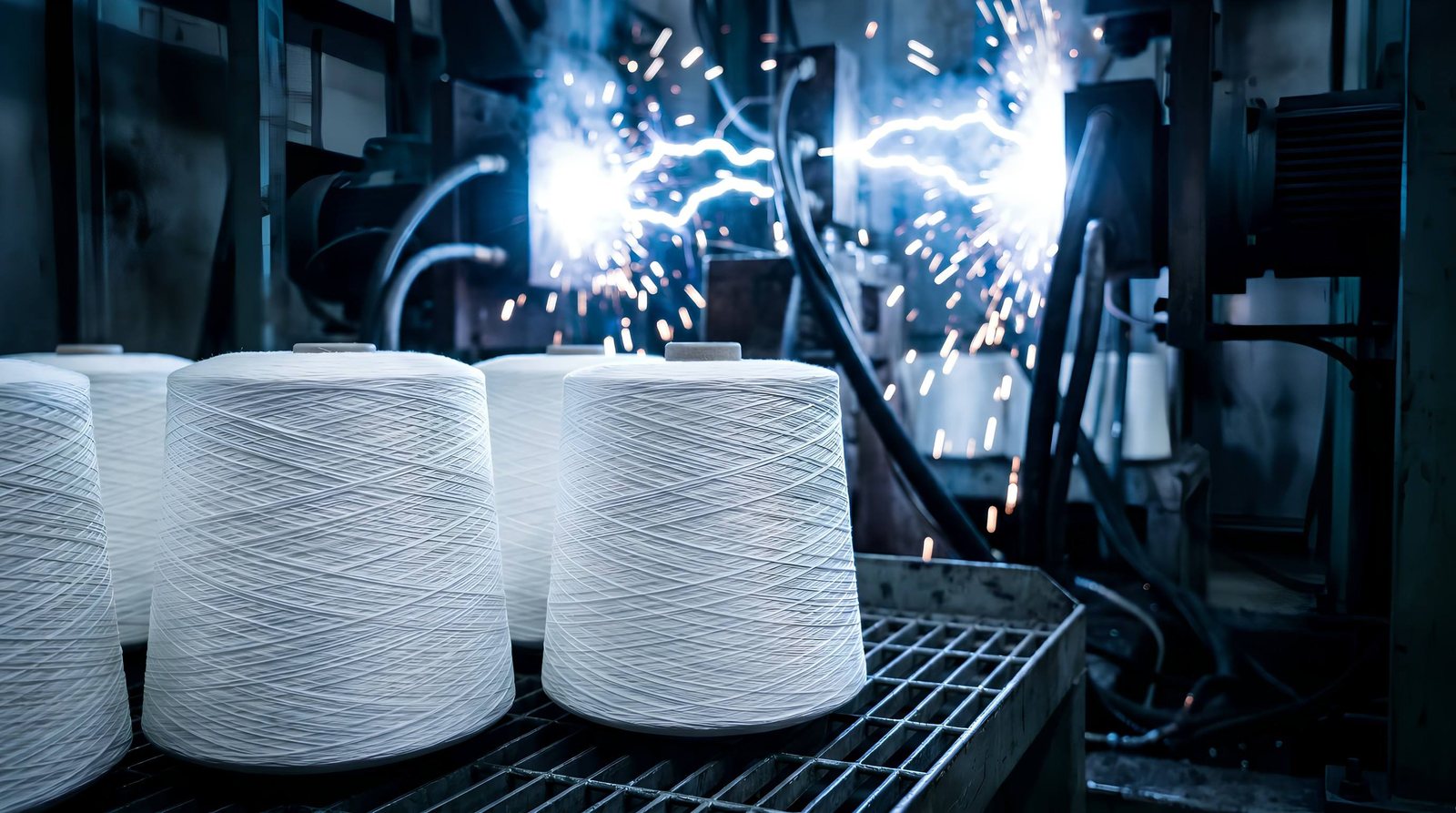
93% meta-aramid / 5% para-aramid / 2% antistatic yarn · Ne 20s – Ne 80s · Solution-dyed or piece-dyed
Our 3A aramid yarn family: the three-component yarn that carries a thermal barrier, a rupture-resistant load path and a permanent antistatic path in one thread. Spun for the mills that weave and knit flame-retardant, antistatic workwear for petrochemical, utility and electrical crews.
The material
The 3A yarn is not a blend of convenience — it is three fibres doing three separate jobs in one thread. The 93% meta-aramid is the thermal barrier: an inherently flame-resistant fibre that chars and builds a carbonised shield instead of melting, and that can be worn against the skin without the clamminess of a melting fibre. The 5% para-aramid is the load path: a much stiffer, much stronger fibre that resists rupture and tearing, so the yarn holds together where a pure meta-aramid thread would part. The 2% antistatic component is the conductive path that lets static charge drain away instead of building on the garment.
The antistatic part is where a 3A yarn differs most from a finish-treated fabric. Because the conductive component is spun into the yarn itself, it is part of the structure rather than something applied to the surface, and it is therefore available on every square centimetre of the fabric rather than depending on a coating surviving the wash cycle. That is what antistatic clothing standards are really asking about — a path that is still there after laundering.
Meta-aramid is an inherently flame-resistant fibre: the flame resistance belongs to the polymer, so laundering, dry cleaning and abrasion cannot remove it. Its limiting oxygen index (LOI) is 28–32 against the 21% oxygen in ordinary air, which is why the yarn self-extinguishes once the ignition source is taken away, and it does not melt or drip — the failure mode that makes a melting fibre dangerous in a garment worn against the body.
With a blend, behaviour follows the mix. The thermal barrier and the rupture resistance are set by the ratio of meta- to para-aramid, and the antistatic performance is set by the conductive component and how evenly it is distributed through the yarn; both are fixed at the spinning stage rather than adjusted later. Thermal and flame performance figures for a specific 3A construction are established by testing the finished fabric, so where a programme needs them we run the test and report the result rather than quoting another fabric's number.
How it is made
We spin our aramid yarn with two ring-spinning variants — Siro-spun and compact Siro-spun. Both start from drafted staple fibre, and both attack the same weakness: a spun yarn is only as good as the fibres held inside its body. That matters more, not less, in a three-component yarn, because the conductive component has to be distributed through the thread instead of collecting in stripes along it.
In conventional ring spinning a single drafted strand is twisted into yarn, and the twist runs back into a triangular zone — the spinning triangle — where outer fibres can escape before they are bound in. Siro-spun feeds two rovings side by side through the same drafting zone and the same spinning triangle, so the two strands twist around each other as they form. The yarn that comes out is wrapped rather than combed: fewer fibre ends protrude, and the linear density is more even along the length of the yarn.
Compact Siro-spun adds a compacting stage before twisting. A suction or air current draws the fibre ends back into the yarn body and removes the spinning triangle altogether, so nearly every fibre is trapped inside the structure instead of lying loose on the surface. In practice that gives the tightest surface, the highest yarn tenacity of the two routes and the best evenness — the reason it is the route we use where the yarn will be woven or knitted into a fabric whose appearance and abrasion life matter.
Even fibre distribution is what a 3A yarn is judged on downstream. A yarn whose components separate into thick and thin places weaves into a fabric with uneven appearance, uneven abrasion life and an antistatic path that is denser in some areas than others. Compact Siro-spun gives the more uniform thread, and it runs cleaner through the loom or the knitting machine, which is why it is the route we recommend for appearance-critical and specification-critical 3A fabric. Yarn properties are measured per production lot, so ask our technical team for the current spinning data for the count and ply you plan to use.
| Spinning route | How the yarn is formed | What it gives the fabric |
|---|---|---|
| Conventional ring-spun | One drafted roving twisted into a yarn; the spinning triangle stays open. | The baseline: usable, but hairier and less even, so the fabric surface is rougher and wears faster. |
| Siro-spun | Two rovings drafted and twisted together in the same spinning triangle, then plied. | Lower hairiness and better evenness than ring-spun; fewer protruding fibre ends on the woven or knitted surface. |
| Compact Siro-spun | As Siro-spun, with a compacting stage that pulls loose fibre ends back into the yarn body before twisting. | The tightest surface, the highest tenacity and the best evenness of the three — our route for appearance-critical fabric. |
Technical data
The 3A yarns we produce, model by model. MD-3A322 is the model with a recorded specification; for the other models in the series the index records the composition but not the count or ply, so those cells read On request rather than a guess.
| Model | Composition | Count | Ply / construction | Rating or key property | Source |
|---|---|---|---|---|---|
| MD-3A322 | 93% meta-aramid + 5% para-aramid + 2% antistatic yarn | Ne 32s | Two-ply | 28.3 tex; breaking force 1072 cN; breaking tenacity 28.3 cN/tex | Index |
| MD-3A202 | 93% meta-aramid + 5% para-aramid + 2% antistatic yarn | On request | On request | On request | Index |
| MD-3A262 | 93% meta-aramid + 5% para-aramid + 2% antistatic yarn | On request | On request | On request | Index |
| MD-3A302 | 93% meta-aramid + 5% para-aramid + 2% antistatic yarn | On request | On request | On request | Index |
| MD-3A402 | 93% meta-aramid + 5% para-aramid + 2% antistatic yarn | On request | On request | On request | Index |
The Source column names where each figure comes from: Index is our product information index. Where a model carries no recorded count, ply or rating we write On request rather than an estimate — ask our technical team for the current specification of the count you need. Values are measured per production lot.
Made to order
3A yarn is supplied either solution-dyed or piece-dyed, and the two routes differ in what they can deliver — count, ply and the meta/para ratio are set to the fabric you are building.
Solution-dyed yarn carries its colour in the polymer and is the choice where a shade has to be identical roll after roll; piece-dyed yarn takes colour after spinning, which opens a wider shade range at the cost of a separate dyeing lot. The shade you specify is matched to the fabric programme rather than to a fixed catalogue card, so send us the reference you are working to.
Our products are made to conform to each standard listed below, in the application it is bought for. Where a certificate for a specific standard is required, we arrange testing to the customer's requirement.
Test reports and certificate copies are available from our sales team on request. Standards written for finished garments — EN ISO 11612, NFPA 2112, NFPA 1971 — belong to the garment maker who builds on our material data.
In service
The 3A yarn is bought by mills that weave or knit it into flame-retardant, antistatic fabric: outer shells for crews working around flammable atmospheres, and knit and woven layers for the garments worn under them. The count and ply decide the weight of the fabric; the spinning route decides how evenly the three components sit in it.
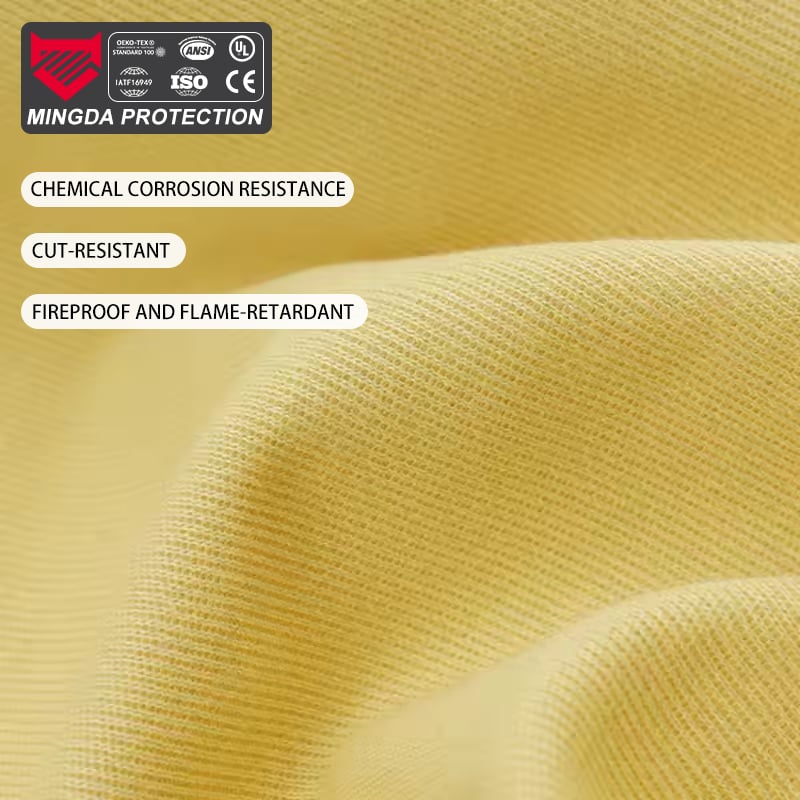
Plain, twill and ripstop constructions for coveralls and jackets in flame-retardant and antistatic programmes, where the garment has to hold both its protection and its shape.
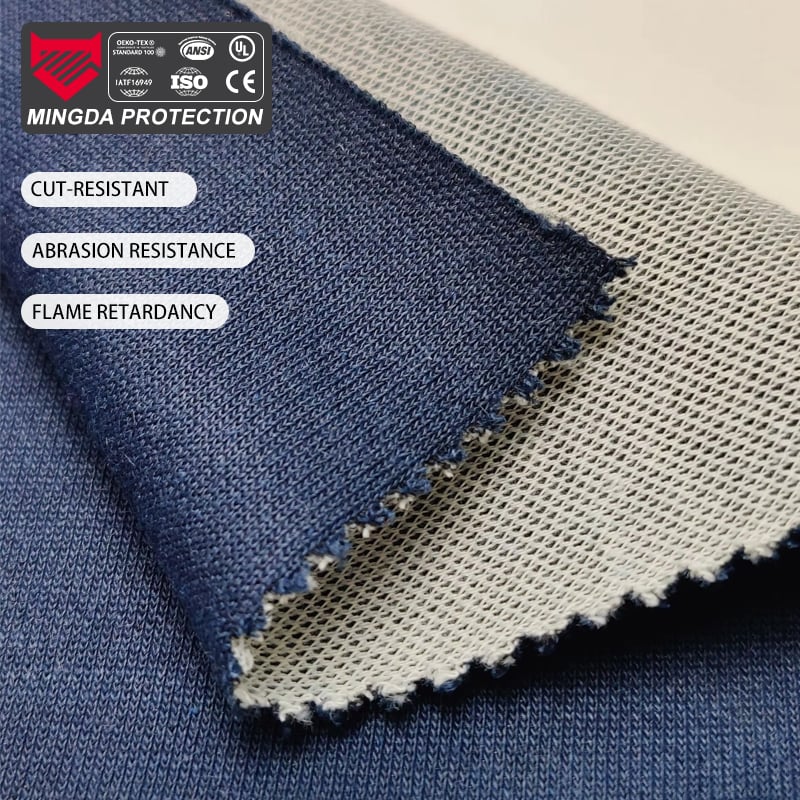
The same fibre family in a loop structure, for the layer against the wearer where breathability and softness decide whether the garment is actually worn done up.
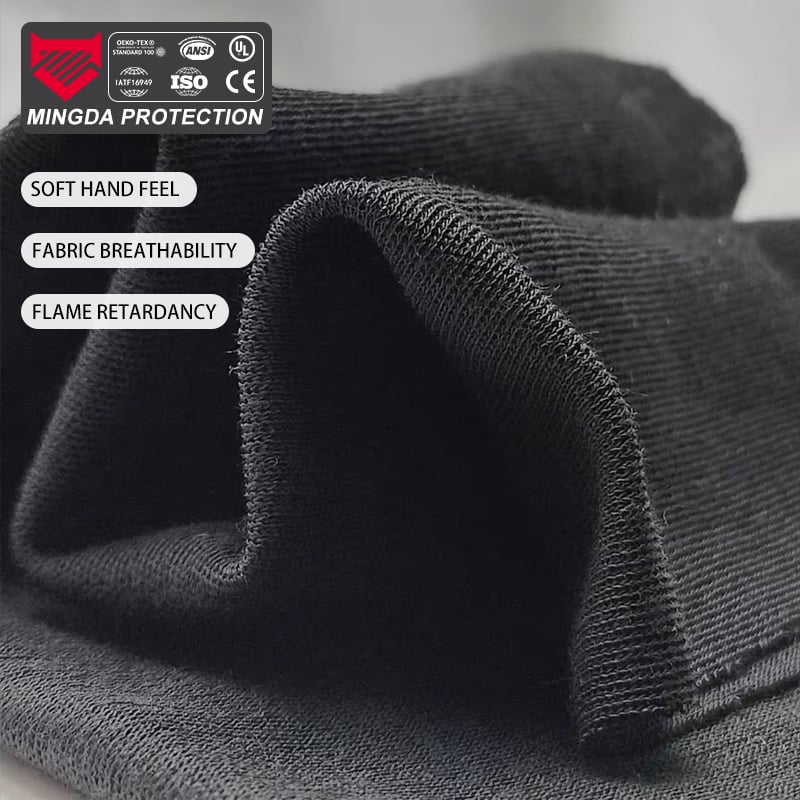
A three-component yarn for the layers behind the shell that have to hold together at temperature without becoming the weak point of the assembly.
The ratio follows the three jobs the yarn has to do at once. 93% meta-aramid supplies the thermal barrier: an inherently flame-resistant fibre that chars instead of melting and insulates the layer behind it. 5% para-aramid supplies the load path: a much stiffer, stronger fibre that resists rupture and tearing so the yarn does not part where a pure meta-aramid thread would. 2% antistatic component supplies a conductive path so static charge drains away instead of building on the garment. Change any of the three and one of the three jobs gets weaker.
It is structural rather than a surface treatment. The conductive component is a fibre spun into the yarn, so it is distributed through every square centimetre of the fabric and is not a finish that can be washed off or worn away. That is the practical difference between a 3A yarn and a fabric treated after weaving — the antistatic requirement in standards such as EN 1149-5 is really a question about what survives laundering.
100% meta-aramid is the better choice when the job is purely thermal: it is softer, it can be worn against the skin, and it has no conductive component to specify around. 3A adds the rupture-resistant fraction and the antistatic path, which is what a petrochemical, utility or electronics programme needs. In practice the two are used together — 3A in the outer shell and hood, 100% meta-aramid or a knit in the layer against the wearer.
There are two routes and they behave differently. Solution-dyed yarn carries the colour in the polymer before the fibre is spun, so the shade is identical roll after roll, which is what a multi-plant uniform programme usually needs. Piece-dyed yarn takes colour after spinning and opens a wider shade range, at the cost of a separate dyeing lot. Which one suits you depends on how tightly the shade has to match across repeat orders.
The thermal side is normally EN ISO 11612 in Europe, NFPA 2112 in the United States, or GB 8965.1 in China, and the electrical side is EN 1149-5 (with EN 1149-1) in Europe or IEC 61340 in electronics and process environments. Arc-rated programmes add ASTM F1506 with ASTM F1959 for the ATPV figure, or IEC 61482-2 in Europe. These certify the finished garment or fabric, so they are established by testing the construction you actually build.
Because the conductive component has to be spread through the thread, not gathered in stripes along it. Siro-spun drafts two rovings together in the same spinning triangle, and compact Siro-spun adds a compacting stage that draws loose fibre ends back into the yarn body before twisting; the result is a more uniform thread, which is what a three-component yarn needs if the antistatic path and the thermal barrier are to be present evenly across the woven or knitted surface.
Tell our technical team the count and ply your fabric programme uses and we will confirm it against the 3A spinning range, which runs from Ne 20s to Ne 80s. MD-3A322 is the model with a recorded specification on this page (Ne 32s/2). For the other models in the series the index records the composition but not the count, so we confirm those against the current production record rather than quoting a figure we cannot trace.
Tell us the application, the required weight and the standard you need to meet. Our technical team will come back with a matching fabric, the spec sheet and a quotation.