Nonwoven and felt: meta-aramid needle felt and pre-oxidised felt
100% meta-aramid (aramid 1313) felt · Pre-oxidised (oxidised PAN) felt · Needle-punched nonwoven · Weight, width and thickness made to order
Our nonwoven and felt class: aramid felt and pre-oxidised felt for thermal and acoustic insulation, linings, hood inner layers and panel cores. A component class — supplied on material-level data, for the maker who builds the part.
- Aramid felt is inherently flame resistant — the property is in the fibre, not in a finish
- A nonwoven built for insulation duty, not as a protective garment outer shell
- Supplied as a component, with material-level data for the production lot
The material
A felt is an insulation structure, not a garment shell
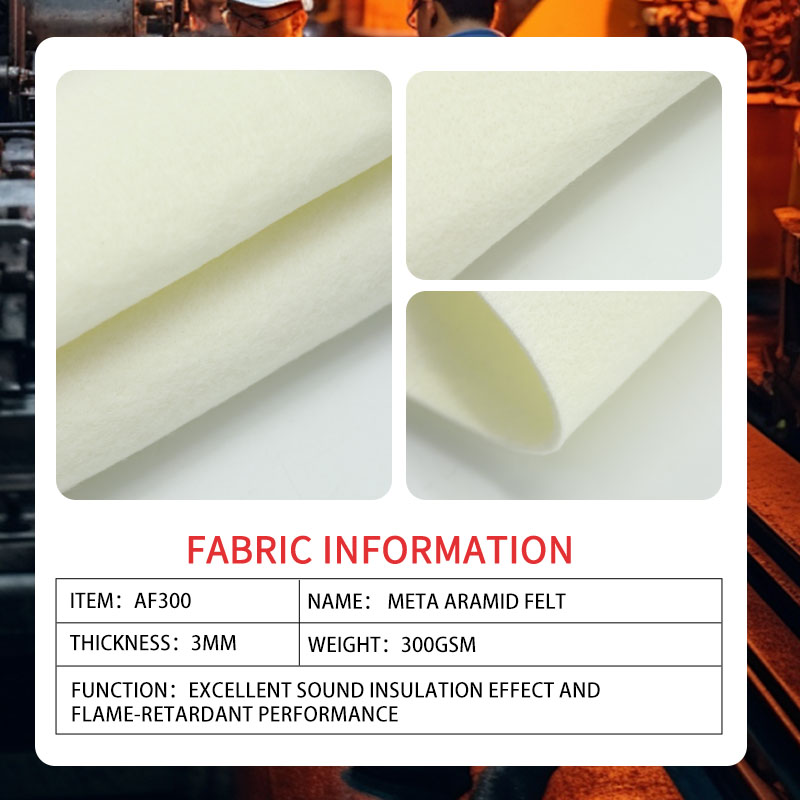
This is an aramid felt: a nonwoven structure of meta-aramid (aramid 1313) staple fibre, needle-punched into a felt. The fibre is inherently flame resistant — the flame resistance belongs to the polymer rather than to a finish applied after the felt is made, so it cannot be washed out or worn off — and it does not melt or drip. Meta-aramid is used continuously at around 250 °C and only begins to decompose above 370 °C, and its limiting oxygen index of 28–32 is well above the 21% oxygen in ordinary air, so it self-extinguishes once the ignition source is removed.
The nonwoven build is the point of the material and it is also its limit. A felt is a low-density structure: its strength is insulation — thermal, acoustic and filtration — rather than the mechanical strength a protective garment outer layer has to carry. That is why the felt is bought as a component and not as a shell, and why which standard applies to it depends entirely on the job it is doing rather than on the fibre it is made from.
Two uses sit under two different standards systems and they are not interchangeable. Used as an industrial protection layer — a glove lining, a heat pad, a thermal lining, the inner layer of a protective hood — the felt sits in the protective-clothing system and is assessed as part of the assembly it goes into. Used as the core of a sound-insulation panel in a data centre or a server room it is a building material, and the test that applies to it is ASTM E84, the surface burning characteristics of building materials. Class A is recorded for our meta-aramid acoustic felt, and the page says plainly that this is a building-material classification and not a protective-clothing result.
The class also covers a second fibre system. Pre-oxidised (oxidised PAN) felt is made from pre-oxidised polyacrylonitrile fibre, which is a different fibre from aramid and is bought for fire-blocking and insulation duty rather than for strength. Our sources record the class and the constructions, but they hold no service-temperature figure, no limiting oxygen index and no weight for that fibre, so none is stated here: the felt is supplied with material data for the lot, and any performance figure is established by testing the construction you order. Laminated with an aluminium facing, the same felt becomes a coated construction, which sits in a different class with its own compliance position and has its own page.
Who makes it
Who makes the felt
Our textile manufacturing roots go back to 1972 and the company was established in Shantou, Guangdong in 2002. The aramid in this felt comes out of a 30,000 m² integrated plant where the fibre is spun and converted under one roof rather than bought in and resold.
This page covers the class as a whole: meta-aramid needle felt, the acoustic grade that goes into sound-insulation panel cores, the soft-hand nonwoven our records carry for linings, and pre-oxidised felt. Weight, width and thickness are set with the order against the part the felt is cut or formed into, and where a programme needs a result at fabric level we test the construction and report that lot rather than quoting a figure from another construction.
Technical data
Product information
The nonwoven and felt constructions our records carry for insulation, lining and panel-core duty. Every figure names its source, and where a record holds no figure we write On request instead of an estimate.
| Series | Composition | Weight | Construction | Key property | Source |
|---|---|---|---|---|---|
| Meta-aramid needle felt | 100% meta-aramid (aramid 1313) | On request | Needle-punched nonwoven felt; width and thickness set with the order | Inherently flame resistant and non-melting; thermal and acoustic insulation | Product record · standards matrix |
| Meta-aramid acoustic felt (AF300) | 100% meta-aramid (aramid 1313) | 300 g/m² | Nonwoven felt; roll width on request | ASTM E84 Class A — surface burning characteristics (building-material test, not a PPE standard) | Product record · standards matrix |
| Aramid nonwoven, soft-hand grade | Aramid nonwoven | 250 g/m² | Nonwoven, soft and breathable; recorded for linings and bag linings | Lining and insulation duty; the legacy record names the fibre only as aramid, so no isomer is claimed | Legacy record |
| Pre-oxidised (oxidised PAN) felt | Pre-oxidised polyacrylonitrile (oxidised PAN) fibre | On request | Nonwoven felt; also supplied laminated with an aluminium facing, which is a coated construction and a separate class | No flame, heat or weight figure is recorded for this fibre in our sources, so none is stated | Product record |
Nonwoven and felt — the constructions we produce
The Source column names where each figure comes from: Product record is the specification our records carry for the construction, Legacy record is the construction as it stands in our legacy catalogue record, and standards matrix is the standards position of the class. The weight and the width of a felt are set with the order against the part it is cut or formed into, so the two weights printed above are the recorded points of the class rather than the limit of what we can make. ASTM E84 is a building-material test for surface burning characteristics: it is not a protective-clothing standard and it is not a garment certification. Two constructions in this class carry no figure at all — the needle felt and the pre-oxidised felt — and they are printed as On request rather than estimated, because no weight or width is recorded for them anywhere in our sources. The soft-hand nonwoven row is printed exactly as the legacy record carries it: the fibre is named there as aramid, without an isomer, so none is claimed.
Made to order
Specification options
Weight, width and thickness are set with the order against the part the felt goes into. Tell us the duty — insulation, lining or panel core — and the roll or sheet form your line runs, and we will confirm the specification and the material data that fit it.
No shade card is held for this class, so the colour chips are not printed here. A felt takes its colour from the fibre and from the carding and bonding route rather than from a dye bath, and the records we carry for this class name no shade. Send the colour reference the panel or the lining calls for and we will confirm what the fibre and the build can actually hold before the order is placed.
Standards and certification
The felt is supplied on material-level data. The items below are the ones we can stand behind for this class today; the test routes are named in the note with their status beside them, and none of them is printed above as a held result.
- ASTM E84 Surface burning characteristics of building materials. Class A is recorded for our meta-aramid acoustic felt, which is the classification a sound-insulation panel core is bought against. This is a building-material test, not a PPE standard.
- ISO 9001 Quality management system.
- REACH SVHC Declaration available on request for the article supplied.
This is a component class and its two uses sit under two standards systems. Used as a protective component — a glove lining, a heat pad, a thermal lining or a hood inner layer — the felt is assessed as part of the assembly it goes into, and the route the class names as the most suitable entry for a nonwoven is EN ISO 14116:2015: the clause of that standard which applies to a nonwoven of this build has to be confirmed with the test house, and the index it produces is established by testing the construction you order. EN ISO 15025:2016 and ASTM D6413 are available at material level on the same basis. Where the felt is used as a hood inner layer under NFPA 2112, it takes the lower testing threshold that standard gives a hood liner, and the certification of the hood belongs to the maker who builds it; NFPA 1970 is a finished firefighter-equipment standard in which the felt takes part as an inner or particulate layer. EN ISO 11612:2015 is written for a garment made of flexible material, and a felt participates in it only where the felt is tested as a lining or a component of the assembly. Where the felt is bought as a cut-resistant liner rather than an insulation layer, EN ISO 13997 is the route, and it has no meaning for a purely insulating use; EN 1149-1 applies only to a build that carries a conductive fibre. Standards written for a finished garment — welding clothing under EN ISO 11611 among them — are not applied to a felt on its own. Used as a building or acoustic panel core the felt is a building material, and the finished panel’s own surface-burning classification belongs to the panel maker. Every route named here is arranged to the customer’s requirement and reported for the production lot. The only classification we hold for this class is the building-material ASTM E84 result printed above: no protective-clothing index, code or class is printed as a held result anywhere on this page. Test reports and certificate copies are available from our sales team on request.
Frequently asked questions
What is aramid felt, and what is it used for?
It is a nonwoven felt made from meta-aramid (aramid 1313) staple fibre, needle-punched into a low-density structure. It is used for thermal and acoustic insulation, as a lining or a heat pad, as the inner layer of a protective hood, and as the core of a sound-insulation panel for data centres and server rooms. It is bought as a component for a part that someone else builds, rather than as a finished garment or a finished panel.
Is the felt flame resistant, and what makes it so?
The aramid felt is, and the reason matters: the flame resistance is a property of the meta-aramid polymer rather than a finish applied to the felt, so it cannot be washed out, worn off or removed by handling. The fibre does not melt or drip; it chars and builds a carbonised barrier. Its limiting oxygen index is 28–32 against the 21% oxygen in ordinary air, so it self-extinguishes once the ignition source is removed. Meta-aramid is used continuously at around 250 °C and only begins to decompose above 370 °C. Those figures belong to the aramid felt. For the pre-oxidised felt in this class our sources hold no flame, heat or weight figure, so none is stated for it on this page.
Is ASTM E84 a protective-clothing standard?
No, and the page says so where the classification is printed. ASTM E84 is the test for the surface burning characteristics of building materials and it reports a class — A, B or C. It applies to this felt because the felt is bought as the core of a building panel, and it states nothing about protective clothing. Felt used as a protective lining goes through the protective-clothing route instead, as a component of the assembly it goes into.
Can the felt be used as a protective lining or a hood inner layer?
Yes. Aramid felt is used as a glove lining, a heat pad, a thermal lining and the inner layer of a protective hood, and in that role it is assessed as a component of the assembly it goes into. What we supply for those uses is material-level data: composition, weight and the fibre properties of the lot. The assessment of the finished article, and its certification, belong to the maker who builds it.
What is pre-oxidised felt, and how does it differ from aramid felt?
It is a felt made from pre-oxidised polyacrylonitrile fibre — oxidised PAN — which is a different fibre system from aramid and is used for fire-blocking and insulation duty. We record it in this class because it is the second fibre the class note names, and because the felt is supplied in the same way: as a component, on material data for the lot. Our sources hold no service-temperature figure, no limiting oxygen index and no weight for the fibre, so no such figure is printed here. Laminated with an aluminium facing the same felt becomes a coated construction, which is a separate class with its own page and its own compliance position.
What weight, width and thickness can you supply?
The weights recorded in the class are 250 g/m² for a soft-hand aramid nonwoven and 300 g/m² for the acoustic grade. The needle felt and the pre-oxidised felt carry no recorded weight or width, so those rows read On request rather than a guess, and width and thickness are set with the order against the cutting or panel line the felt runs on. Tell us the part and the form you need and we will confirm the specification and the material data for it.
How do I verify the material data before ordering?
Ask for the test report for the production lot. Composition, weight and the fibre data are recorded per lot, and the ASTM E84 classification is the building-material surface-burning result held for our meta-aramid acoustic felt. Where the felt is going into a protective assembly, the test route is agreed with the requirement of that assembly. Where your own approval file needs an independent result, third-party test reports can be provided on request.
Let’s talk about your fabric requirements
Tell us the application, the required weight and the standard you need to meet. Our technical team will come back with a matching fabric, the spec sheet and a quotation.